
HTB Sherlock: Nubilum-1
AWS CloudTrail investigation of unauthorized EC2 activity, exposed S3 access, attacker infrastructure changes, and PoshC2 activity.
This write-up is based on the exported investigation notes and focuses on the activity timeline, CloudTrail pivots, and key AWS artifacts observed during the case.
Case Summary
The cloud administration team received an AWS warning that an EC2 instance in their environment was being used for malicious activity. The system administrator did not remember deploying the instance and later found more than six unexpected EC2 instances running in the account.
During the interview, the administrator confirmed several important points:
- Most of the suspicious EC2 instances were deleted, except the instance suspected of malicious use.
- No additional controls were added after discovery, such as MFA, IP allowlisting, or stronger S3 access restrictions.
- The team frequently used an S3 bucket for backups, static websites, and scripts.
- The team usually accessed the AWS console or APIs from
86.5.206.0/24. - The S3 bucket was intentionally accessible globally without authentication.
The investigation data included S3 directory listings under /forela-storage/, a Phase 1 UNIX
collection, and AWS CloudTrail logs.
Investigation Goals
The main questions for the case were:
- Which AWS API activity came from suspicious infrastructure?
- When did the attacker first interact with the AWS environment?
- Which EC2 instances, key pairs, and security groups were created or modified?
- How did the activity connect to the suspected C2 host?
- What did the administrator do after discovering the unauthorized instances?
Evidence Sources
Key artifacts used in the investigation:
- AWS CloudTrail JSON logs for account
949622803460 - S3 directory data under
/forela-storage/ - Phase 1 UNIX collection from the suspicious EC2 instance
- PoshC2 logs from the suspected C2 host
- Interview notes from the cloud system administrator
CloudTrail Preparation
The CloudTrail data contained 39,446 records. I flattened the nested CloudTrail JSON files into a single line-delimited file for easier searching and aggregation.
find CloudTrail/949622803460/CloudTrail/ -name '*.json' -exec cat {} + \
  | jq -c '.Records[]' \
| wc -l39446find CloudTrail/949622803460/CloudTrail/ -name '*.json' -exec cat {} + \
| jq -c '.Records[]' \
> cloudtrail.jsonFirst Pivot: Suspicious Source IPs
The administrator stated that normal AWS activity should come from 86.5.206.0/24. I therefore
started by grouping CloudTrail activity by identity and source IP, excluding common private
address ranges.
NOT (
  sourceIPAddress="10.0.0.0/8"
  OR sourceIPAddress="172.16.0.0/12"
  OR sourceIPAddress="192.168.0.0/16"
)
| stats values(sourceIPAddress) as sourceIPAddresses by userIdentity.arn
The suspicious public range was 95.181.232.0/24. A WHOIS lookup of 95.181.232.9 supported
treating this range as attacker-controlled infrastructure rather than expected administrator
activity.
sourceIPAddress="95.181.232.0/24"
| stats min(eventTime), max(eventTime)
The suspicious range appeared in CloudTrail between:
- First event:
2023-01-24T22:48:34Z - Last event:
2023-01-25T14:35:02Z
AWS API Activity From The Suspicious Range
The next step was counting event names for activity from 95.181.232.0/24.
sourceIPAddress="95.181.232.0/24"
| stats count by eventName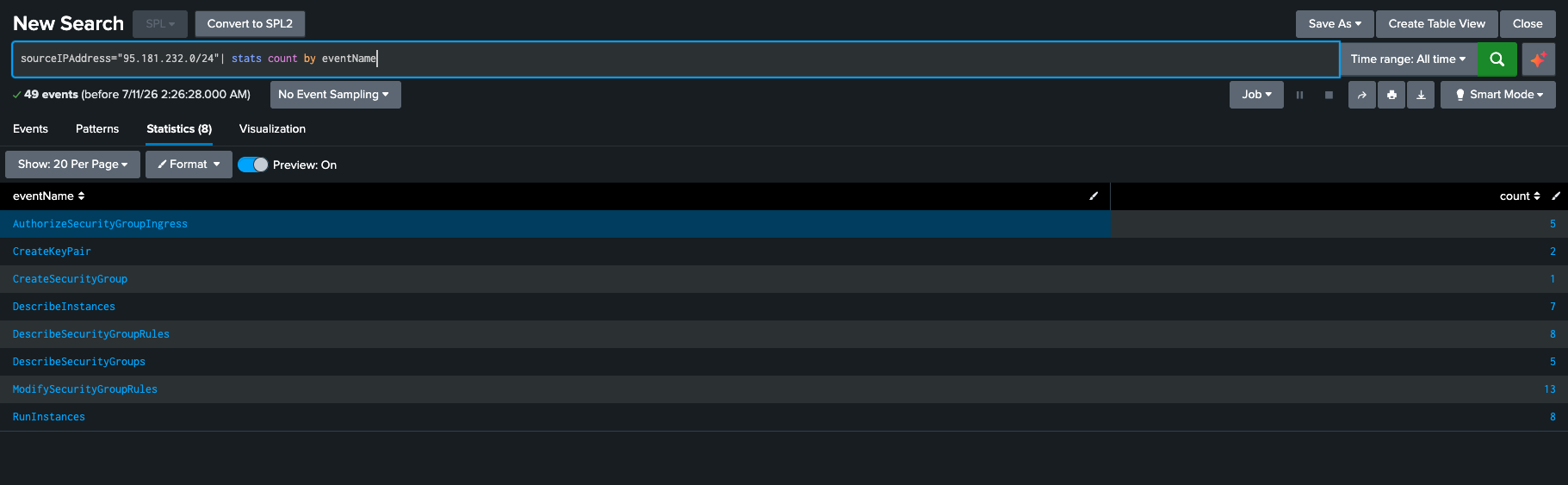
The major event types were:
RunInstances: EC2 instance launchesCreateKeyPair: SSH key pair creationCreateSecurityGroup: security group creationAuthorizeSecurityGroupIngress: security group ingress changesModifySecurityGroupRules: security group rule modificationDescribeInstances,DescribeSecurityGroups, andDescribeSecurityGroupRules: environment discovery
This pattern matches an attacker preparing infrastructure, opening access, and repeatedly enumerating the account state.
Security Group Evidence
Filtering for security group creation and enumeration showed activity from the same suspicious source range.
sourceIPAddress=95.181.232.0/24
eventName=CreateSecurityGroup OR eventName=DescribeSecurityGroups
| sort eventTime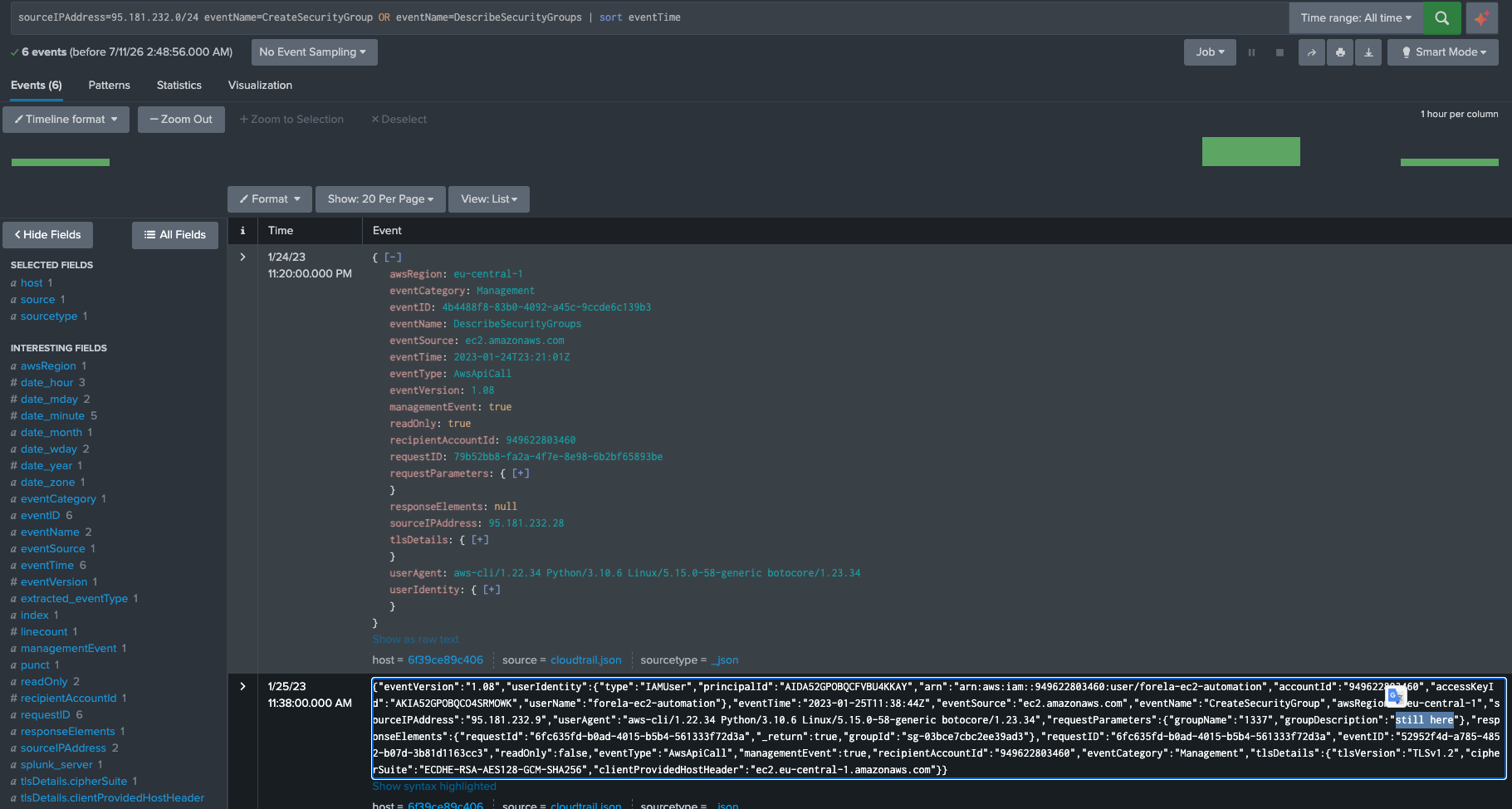
One key event showed the IAM user forela-ec2-automation creating a security group named
1337 from 95.181.232.9 using the AWS CLI:
userIdentity.userName: forela-ec2-automation
sourceIPAddress: 95.181.232.9
userAgent: aws-cli/1.22.34 Python/3.10.6 Linux/5.15.0-58-generic botocore/1.23.34
eventName: CreateSecurityGroup
groupName: 1337
awsRegion: eu-central-1
Timeline
January 24, 2023
22:36:58Z:ec2.pywas downloaded by the attacker IP.22:37:59Z:ec2.pywas downloaded again by the attacker IP.22:48:34Z: First CloudTrail event from the suspicious activity window.22:48:34Z: Key pair1337.keywas created.22:54:45Z:RunInstancesactivity launched sixt2.microEC2 instances across three commands using1337.key.23:10:27Z: Security group rules were modified.23:25:55Z: The administrator terminated six EC2 instances.
January 25, 2023
11:38:44Z: Security group13337was created.11:51:02Z:RunInstanceslaunched fivet2.microEC2 instances using1337.key.11:56:46Z: SixDescribeSecurityGroupRulesandAuthorizeSecurityGroupIngressevents showed security group enumeration and ingress modification.12:01:38Z: Artifact13337was created.12:02:25Z:RunInstanceslaunched onet2.microEC2 instance using13337.13:41:44Z: Two additionalAuthorizeSecurityGroupIngressevents showed further ingress changes.13:59:00Zto14:03:02Z: Two failed instance launches and one successfult2.microlaunch occurred using13337.14:03:00Z:last-utmp.txtfrom the CatScale collection showed the last boot time of the PoshC2 EC2 instance.14:35:02Z: Last observed CloudTrail activity from the attacker IP range.15:00:46Z: PoshC2 logs showed victim activity fromDESKTOP-R4KM0GJ\Marcus Athony.15:11:37Z: The administrator terminated six EC2 instances.
Findings
The investigation points to unauthorized use of the forela-ec2-automation IAM user from
95.181.232.0/24.
The attacker created or used key material named 1337.key and 13337, launched multiple
t2.micro EC2 instances, and changed security group ingress rules to support access to those
instances. The activity was performed through the AWS CLI rather than the console, which aligns
with scripted infrastructure deployment.
The second day shows repeated instance launch attempts and security group changes shortly before
the CatScale collection records the PoshC2 host booting. Later PoshC2 logs show interaction from
the victim workstation DESKTOP-R4KM0GJ, connecting the cloud abuse to post-exploitation
activity.
Lessons Learned
- Public S3 access should be treated as an exposure risk, especially when buckets contain scripts, backups, or deployment material.
- MFA and source IP restrictions would have reduced the likelihood of successful AWS API abuse.
- Terminating suspicious EC2 instances is not enough. Compromised IAM users, access keys, key pairs, security groups, and persistence mechanisms must also be reviewed and revoked.
- CloudTrail event grouping by
sourceIPAddress,eventName,userAgent, anduserIdentityquickly separates expected administrator behavior from attacker automation.