SIEM Analysis Using Splunk BOTS v1
SIEM analysis report converted from PDF to MDX format.
Question 101
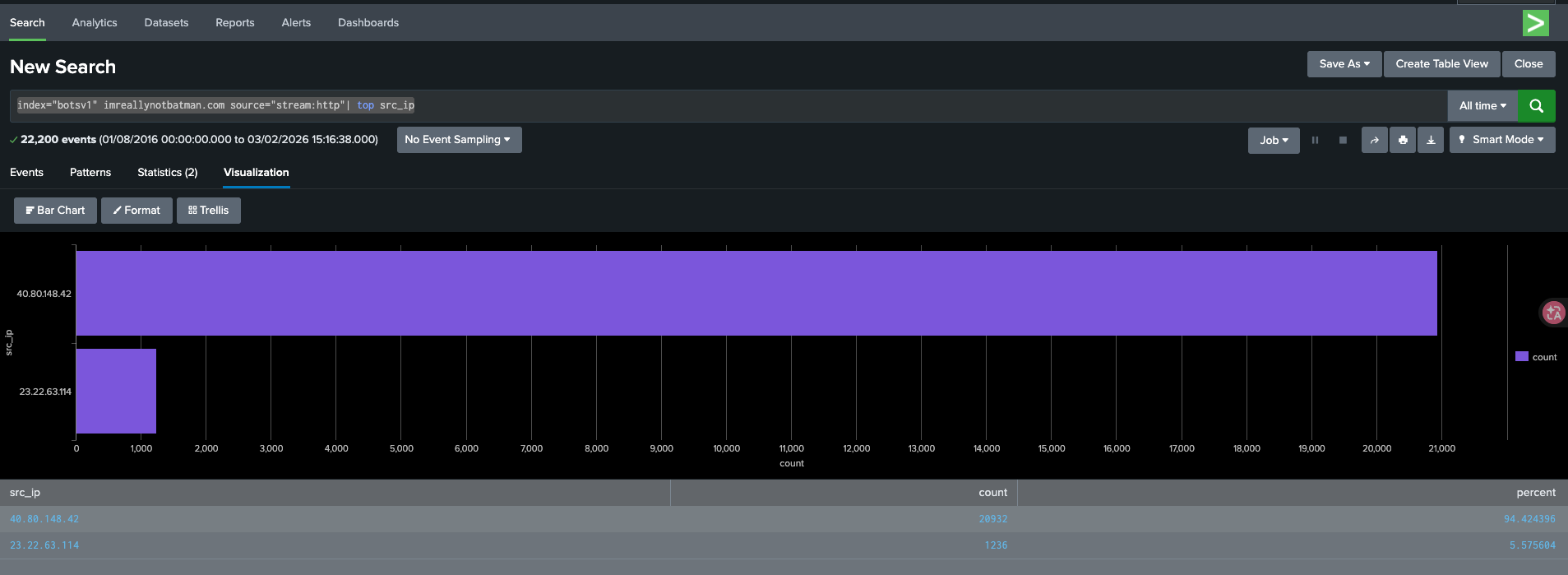
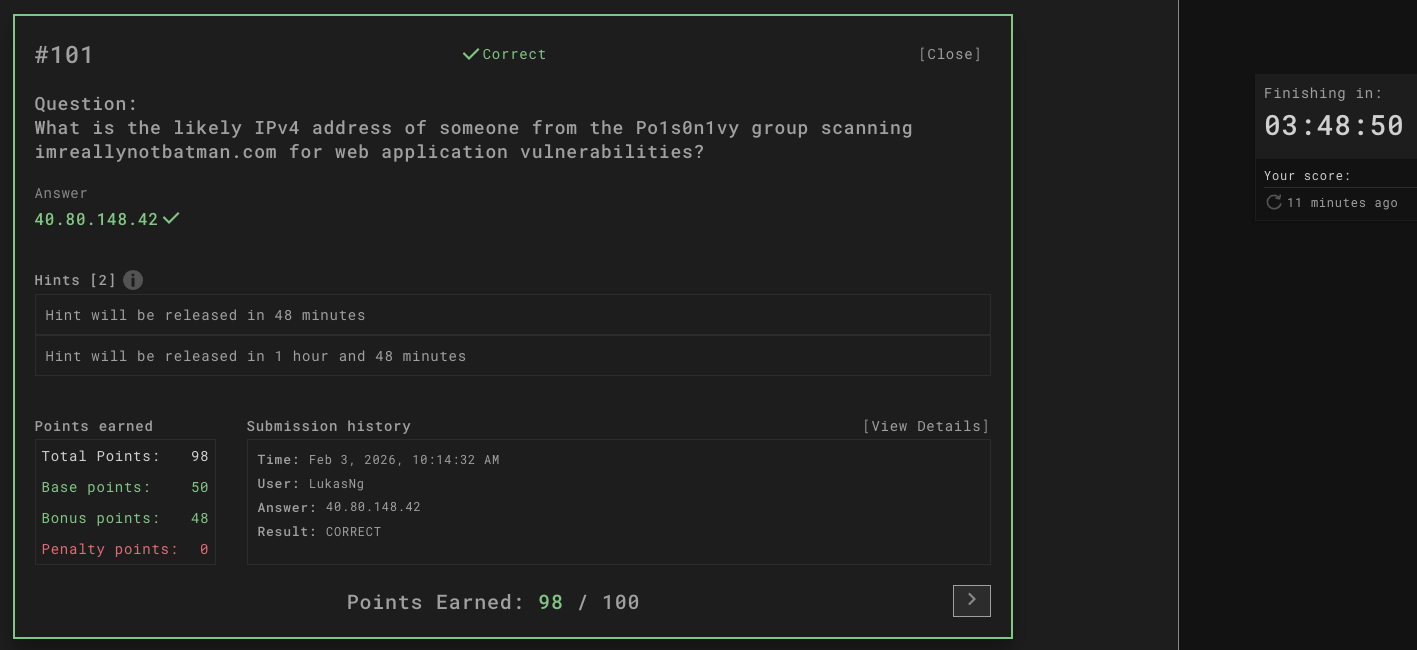
Question: What is the likely IPv4 address of someone from the Po1s0n1vy group scanning imreallynotbatman.com for web application vulnerabilities?
Answer: 40.80.148.42
Splunk Query
index="botsv1" imreallynotbatman.com source="stream:http" | top src_ipNotes
index="botsv1": search only thebotsv1dataset.imreallynotbatman.com: keep events that mention this domain.source="stream:http": restrict to HTTP logs collected by Splunk Stream.top src_ip: ranks the most common source IPs. The top IP is most likely the scanner.
Screenshots
Question 102
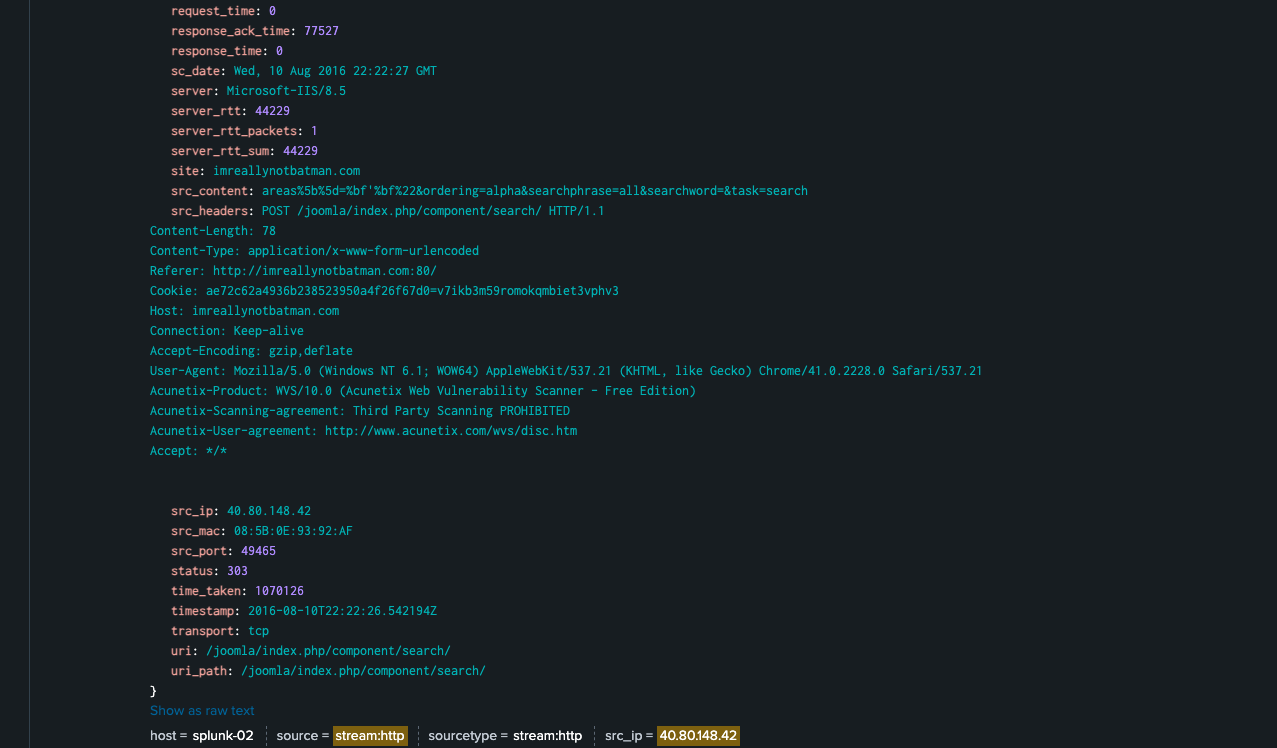
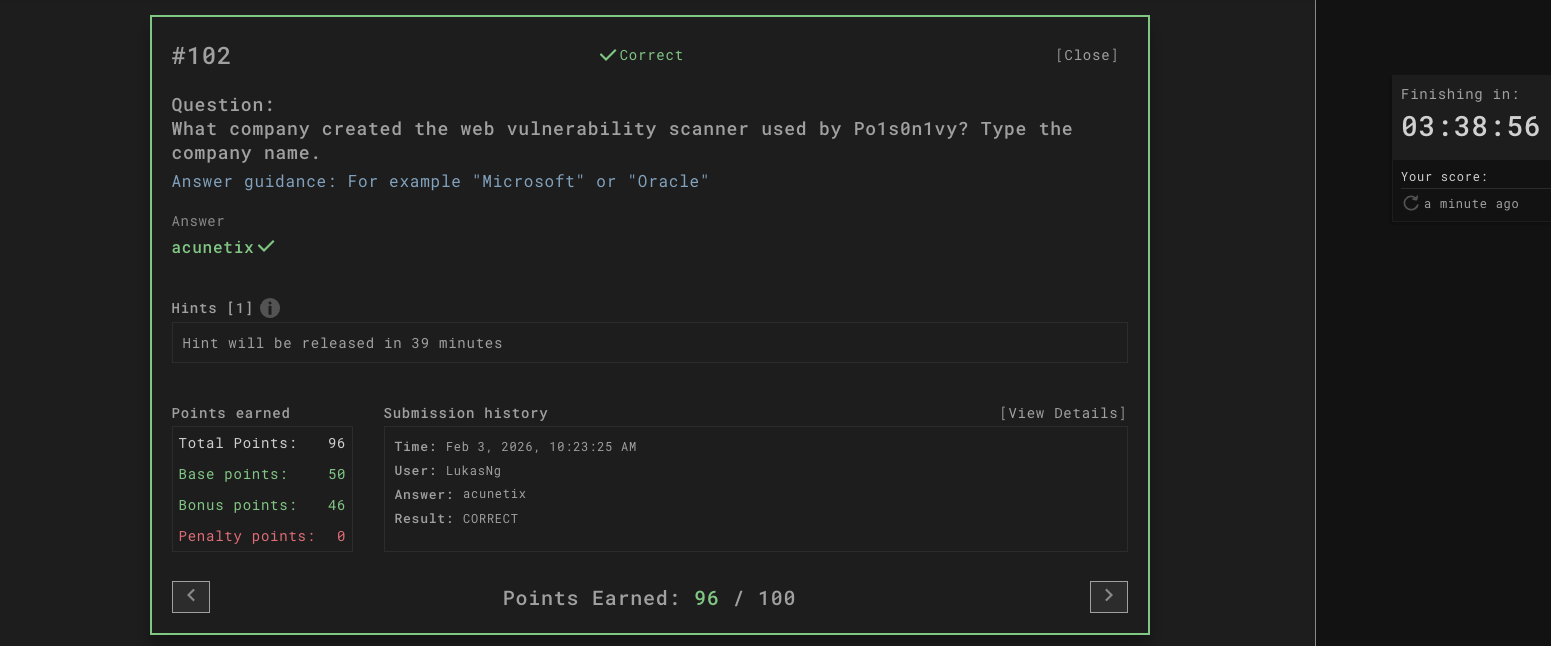
Question: What company created the web vulnerability scanner used by Po1s0n1vy? Type the company name.
Answer: Acunetix
Splunk Query
index="botsv1" imreallynotbatman.com source="stream:http" src_ip="40.80.148.42"Notes
src_ip="40.80.148.42"reuses the scanner IP from Question 101.- Reviewing request headers (
src_headers) identifies the scanner software as Acunetix.
Screenshots
Question 103
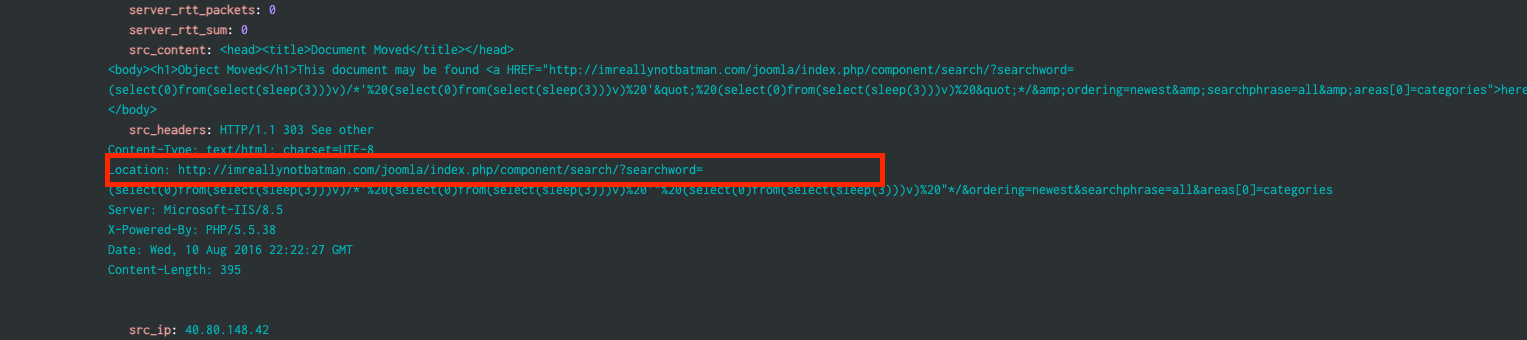
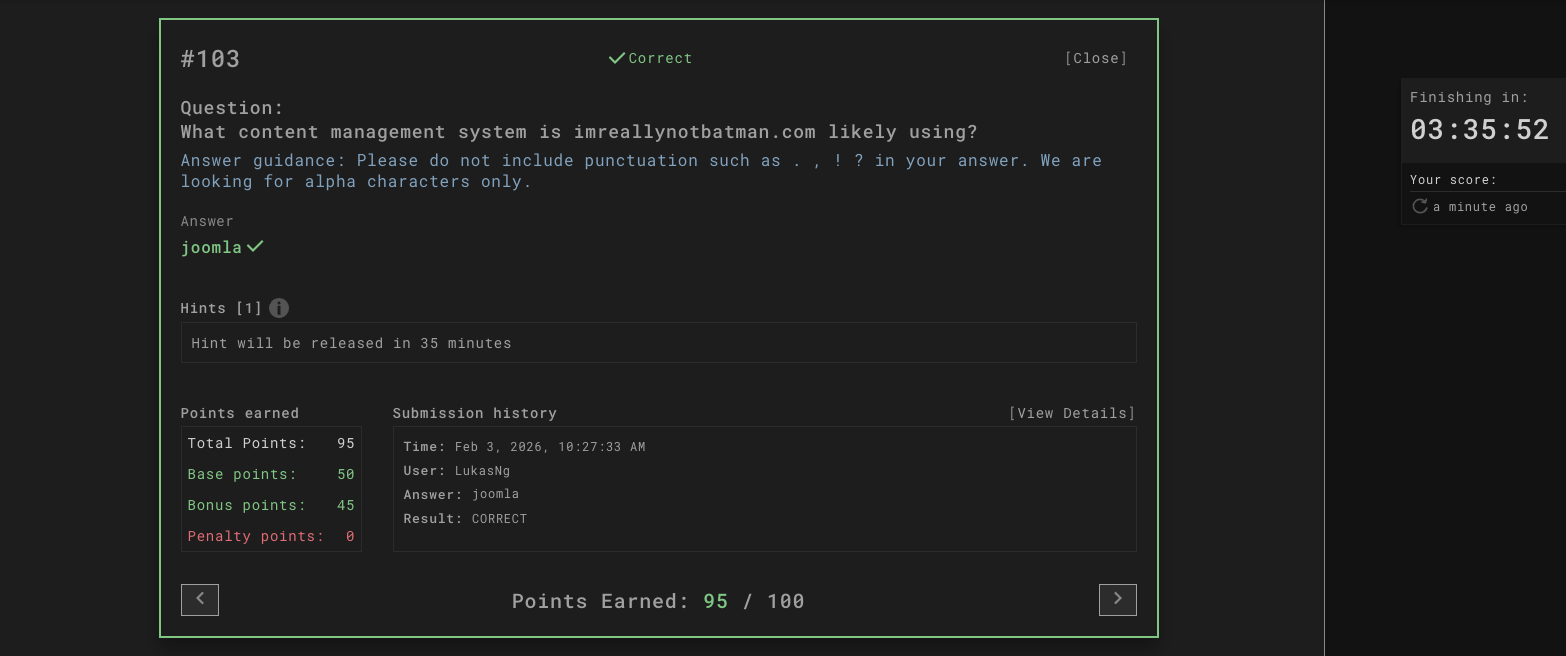
Question: What content management system is imreallynotbatman.com likely using?
Answer: Joomla
Splunk Query
index="botsv1" imreallynotbatman.com source="stream:http" src_ip="40.80.148.42"Notes
The CMS was identified from CMS-specific request paths and signatures in web traffic.
Screenshots
Question 104
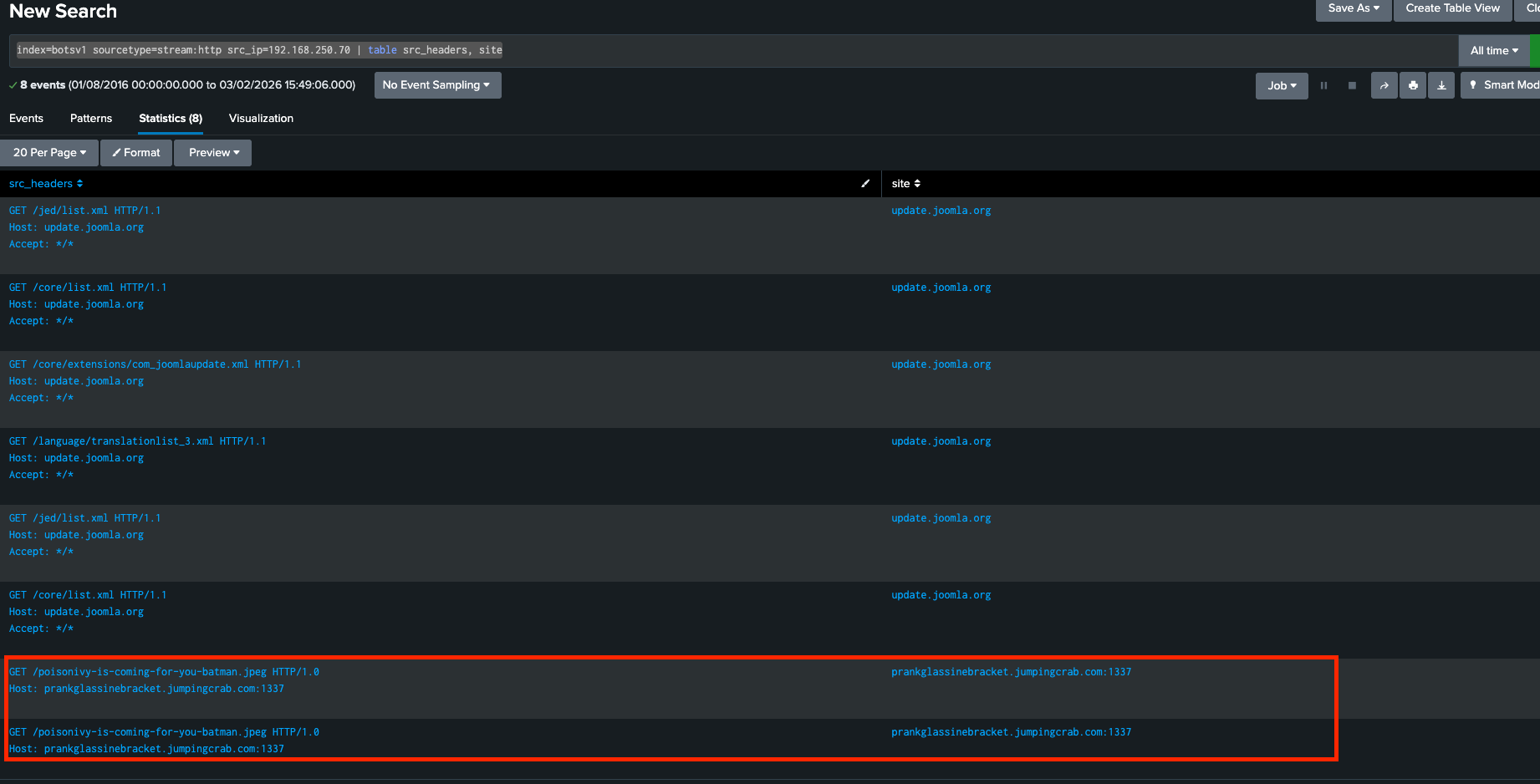
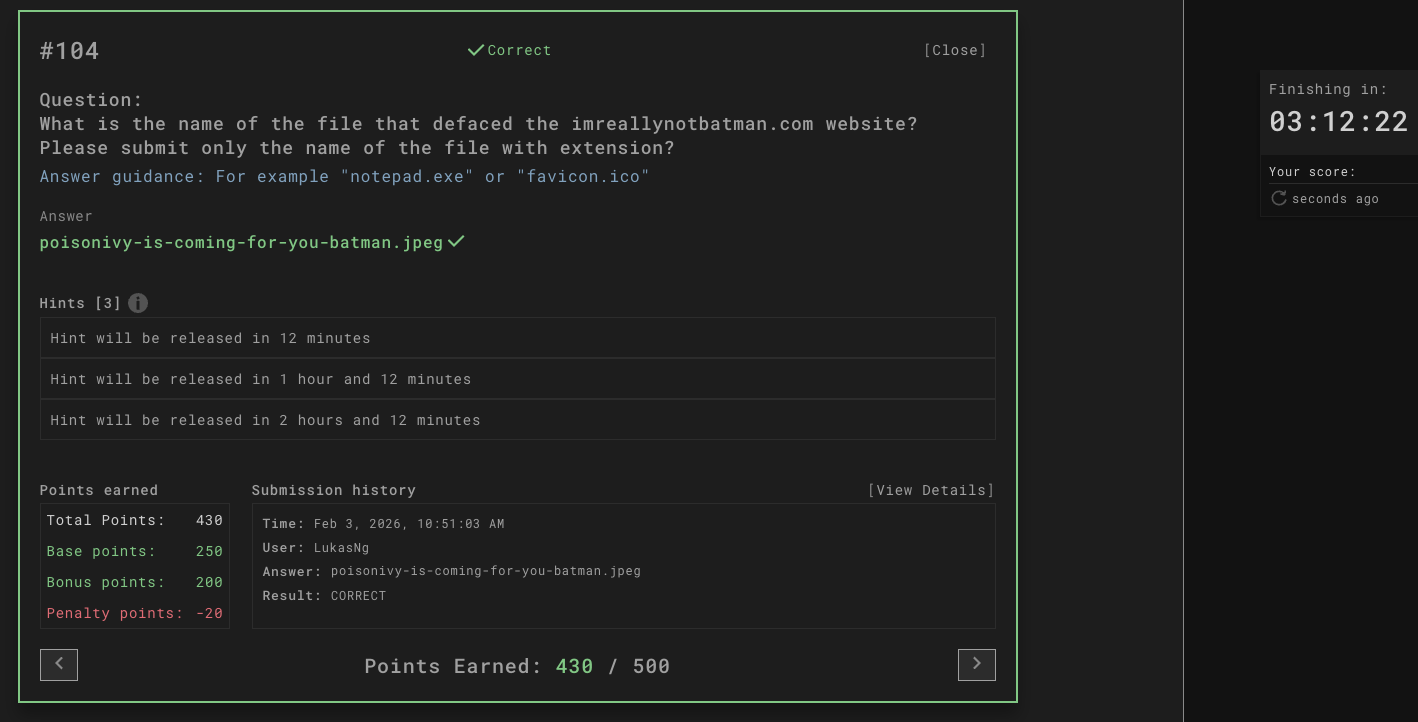
Question: What is the name of the file that defaced the imreallynotbatman.com website? Please submit only the name of the file with extension?
Answer: poisonivy-is-coming-for-you-batman.jpeg
Splunk Query
index=botsv1 sourcetype=stream:http src_ip=192.168.250.70 | table src_headers, siteNotes
The defacement filename appears in request path / related HTTP log fields.
Screenshots
Question 105
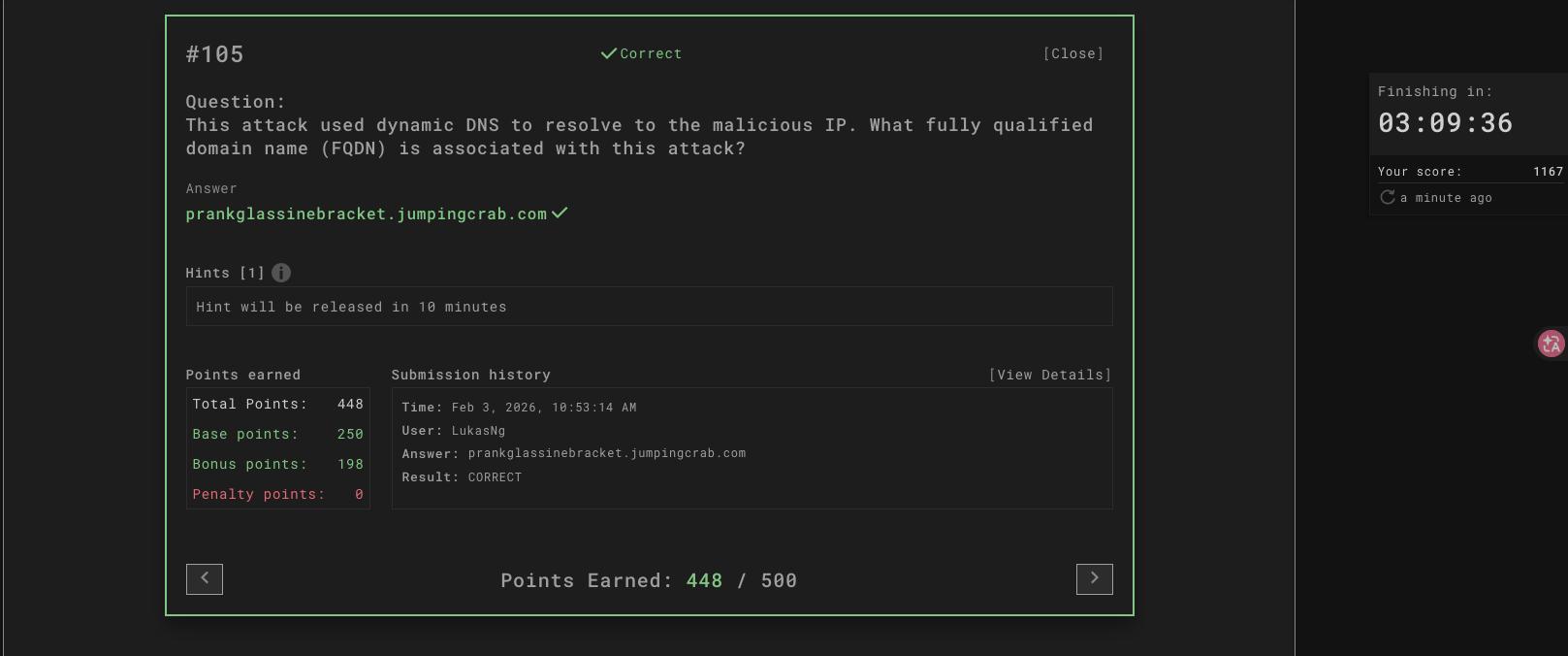
Question: This attack used dynamic DNS to resolve to the malicious IP. What fully qualified domain name (FQDN) is associated with this attack?
Answer: prankglassinebracket.jumpingcrab.com
Notes
The FQDN was identified from the same defacement-related traffic used in Question 104.
Screenshots
Question 106
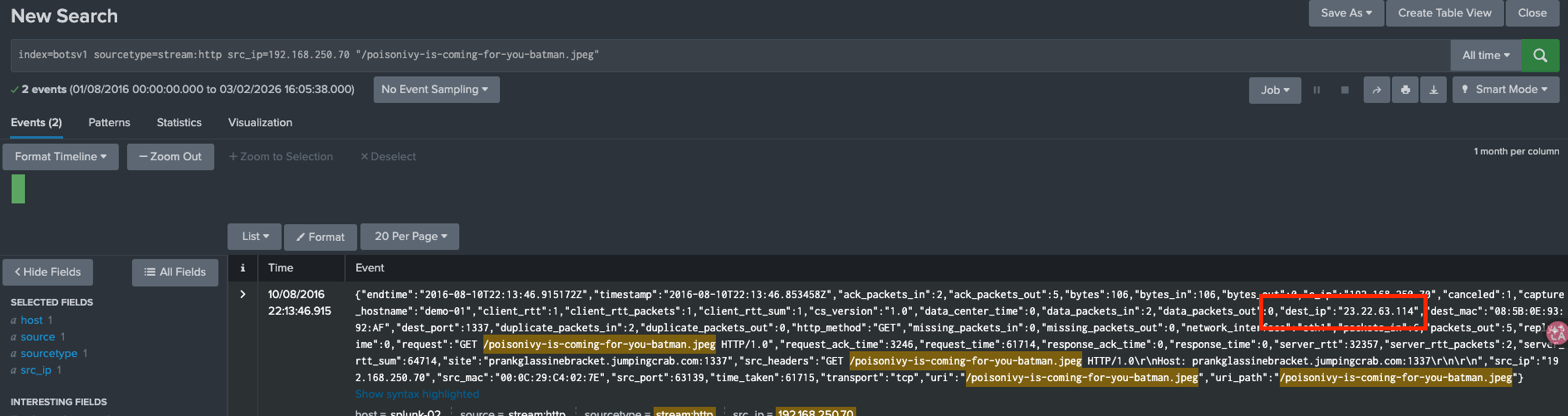
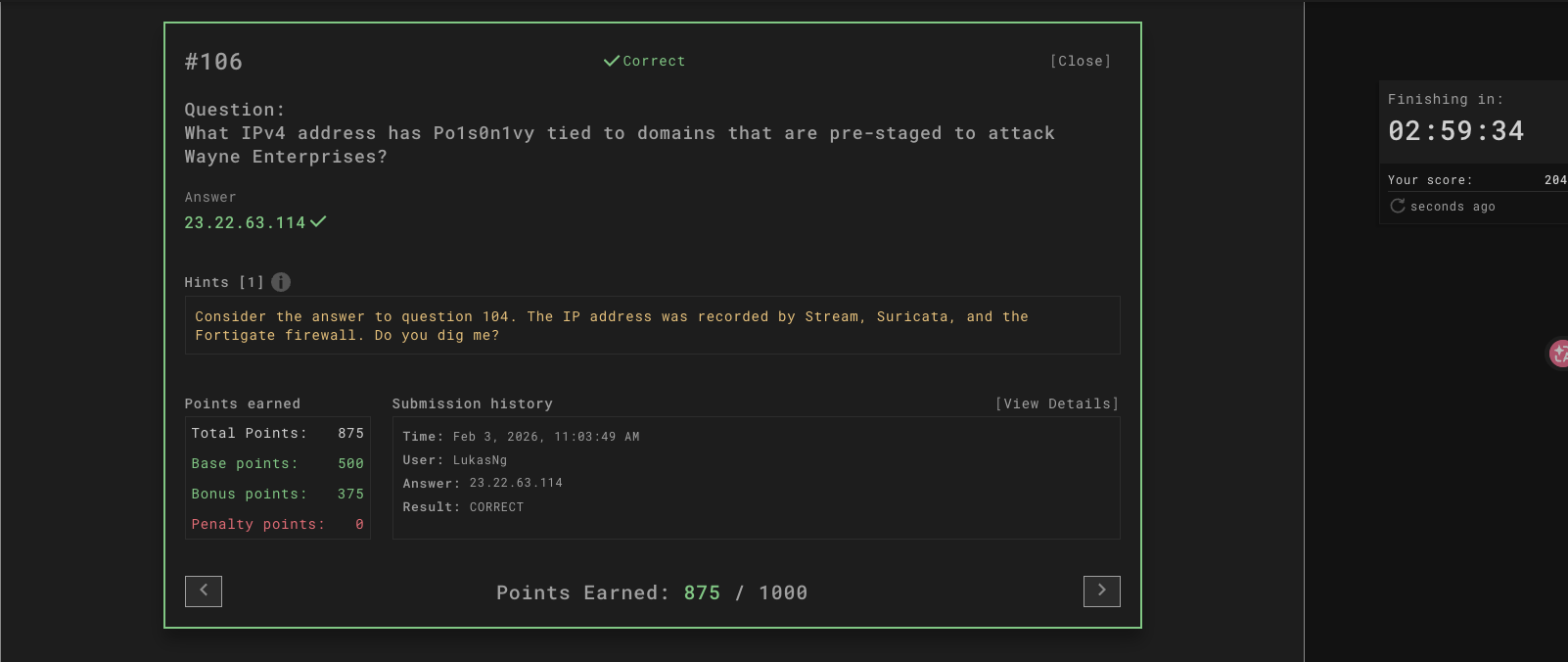
Question: What IPv4 address has Po1s0n1vy tied to domains that are pre-staged to attack Wayne Enterprises?
Answer: 23.22.63.114
Splunk Query
index=botsv1 sourcetype=stream:http src_ip=192.168.250.70 "/poisonivy-is-coming-for-you-batman.jpeg"Notes
This traces the defacement file request to identify the destination IP tied to malicious pre-staged domains.
Screenshots
Question 108
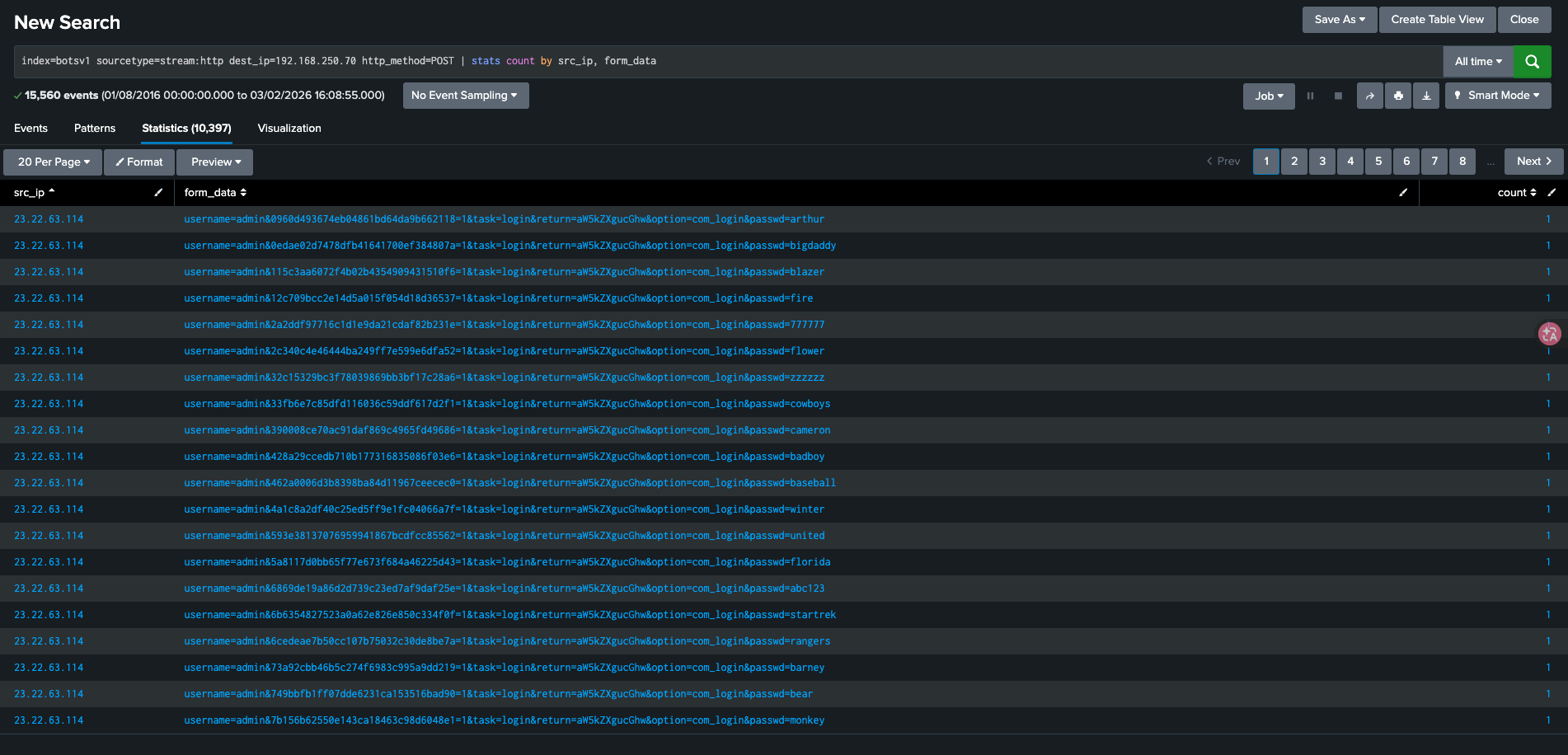
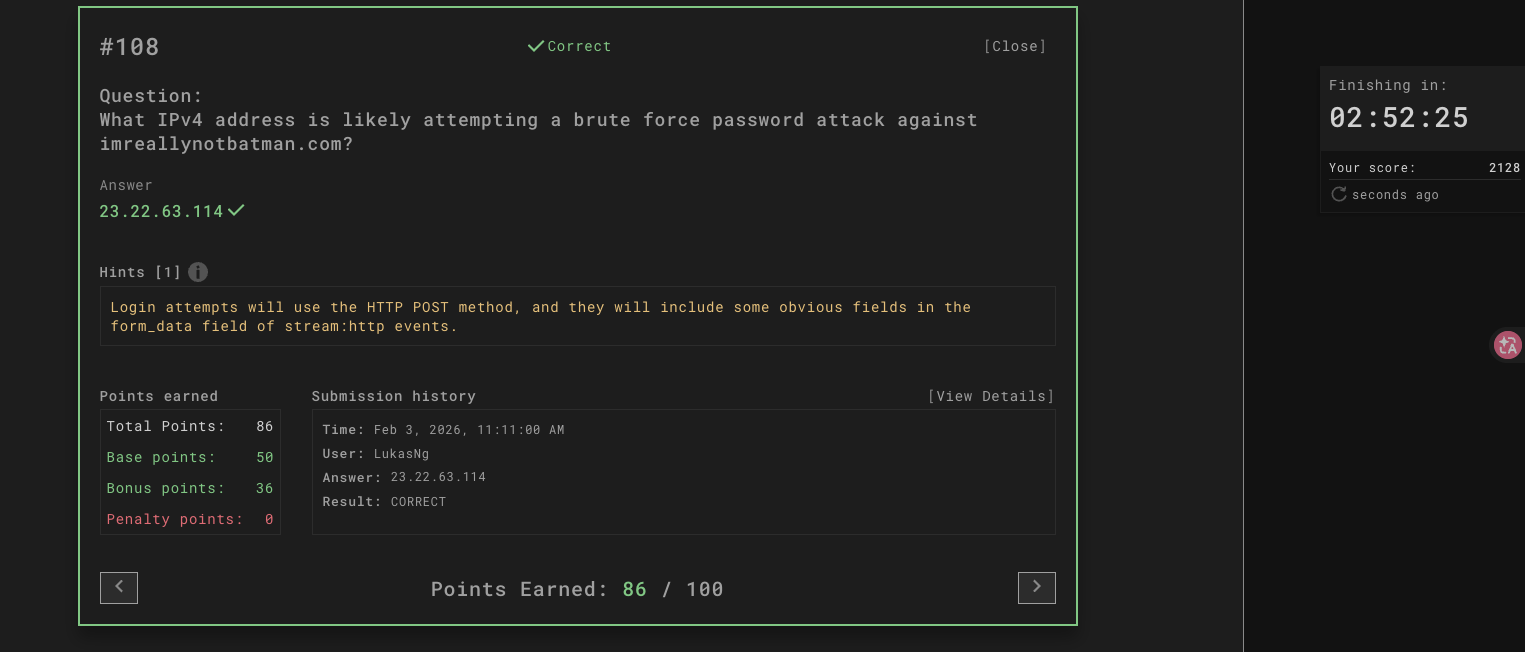
Question: What IPv4 address is likely attempting a brute force password attack against imreallynotbatman.com?
Answer: 23.22.63.114
Splunk Query
index=botsv1 sourcetype=stream:http dest_ip=192.168.250.70 http_method=POST | stats count by src_ip, form_dataNotes
High volume POST attempts with form data indicate brute-force behavior.
Screenshots
Question 109
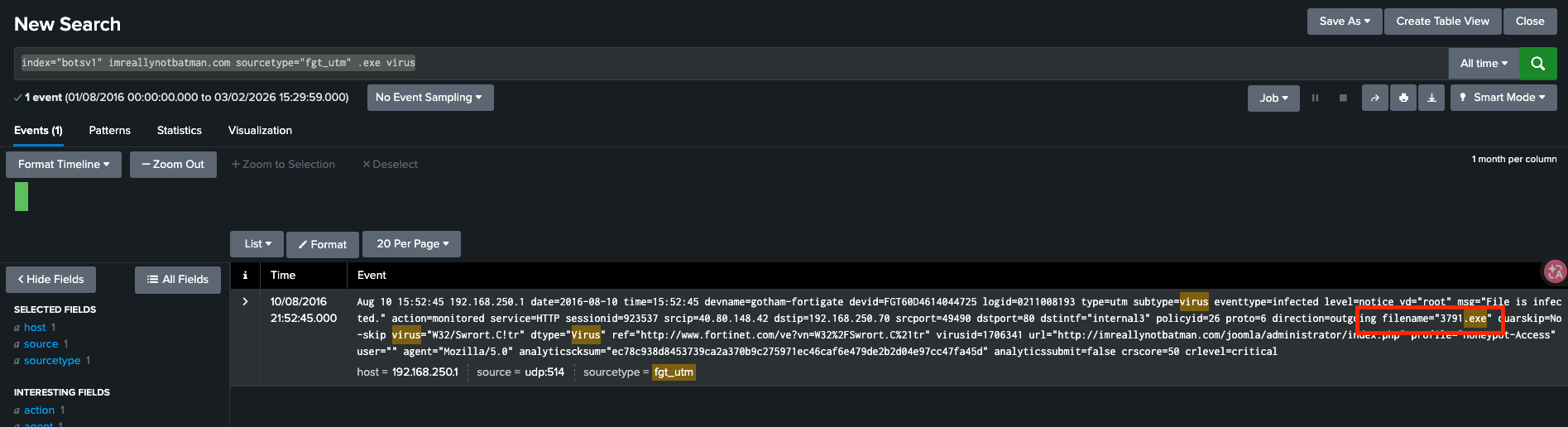
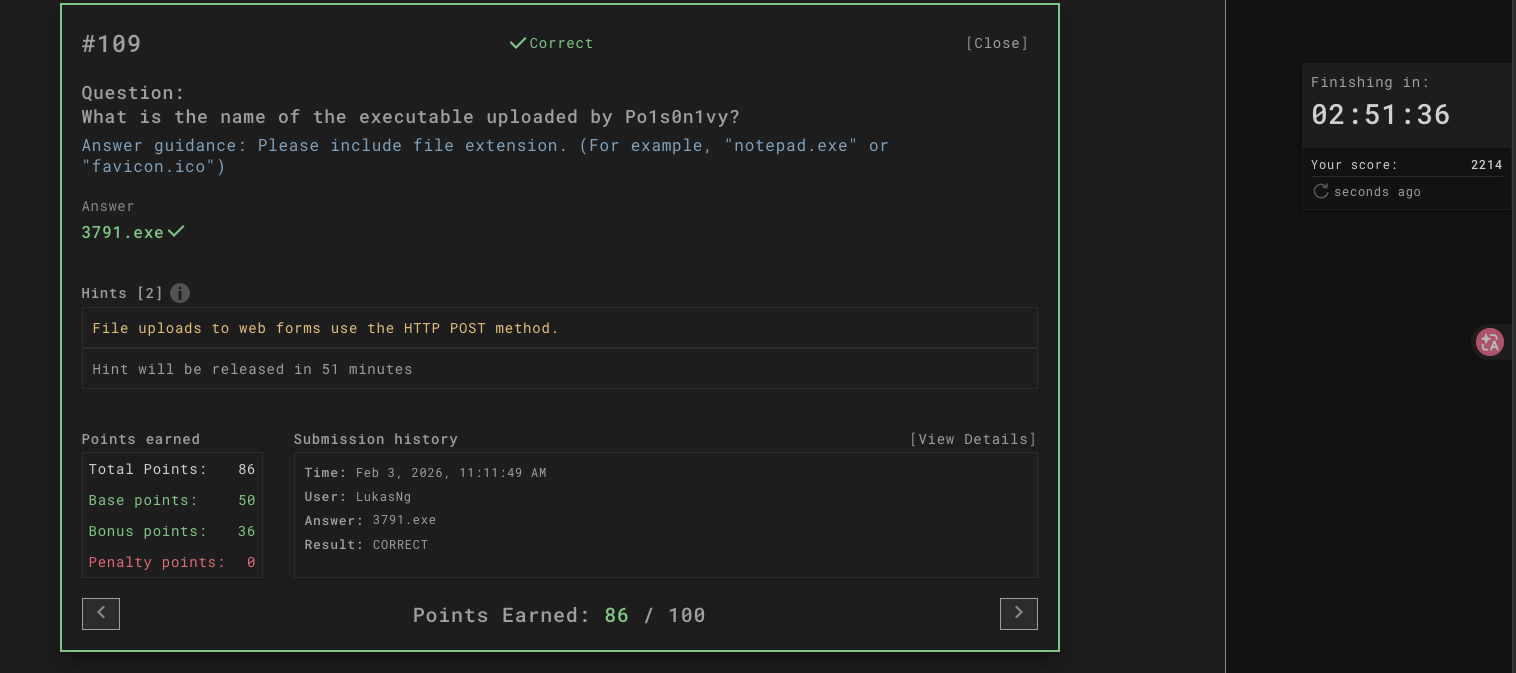
Question: What is the name of the executable uploaded by Po1s0n1vy?
Answer: 3791.exe
Splunk Query
index="botsv1" imreallynotbatman.com sourcetype="fgt_utm" .exe virusNotes
UTM logs reveal malware transfer details including the uploaded executable name.
Screenshots
Question 110
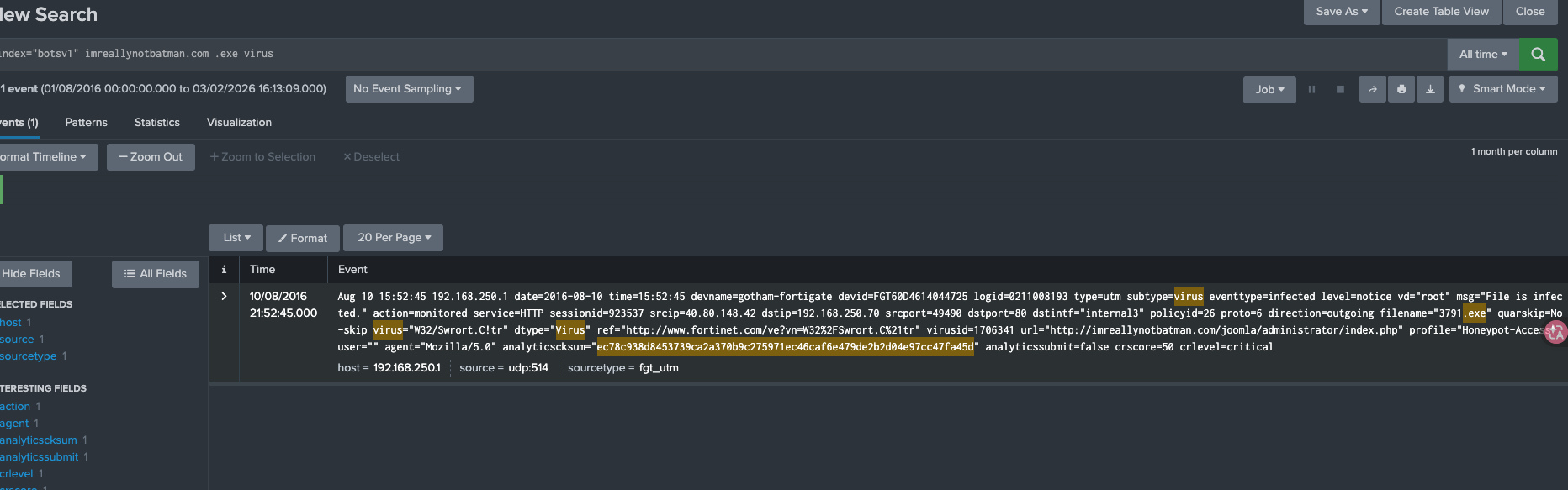
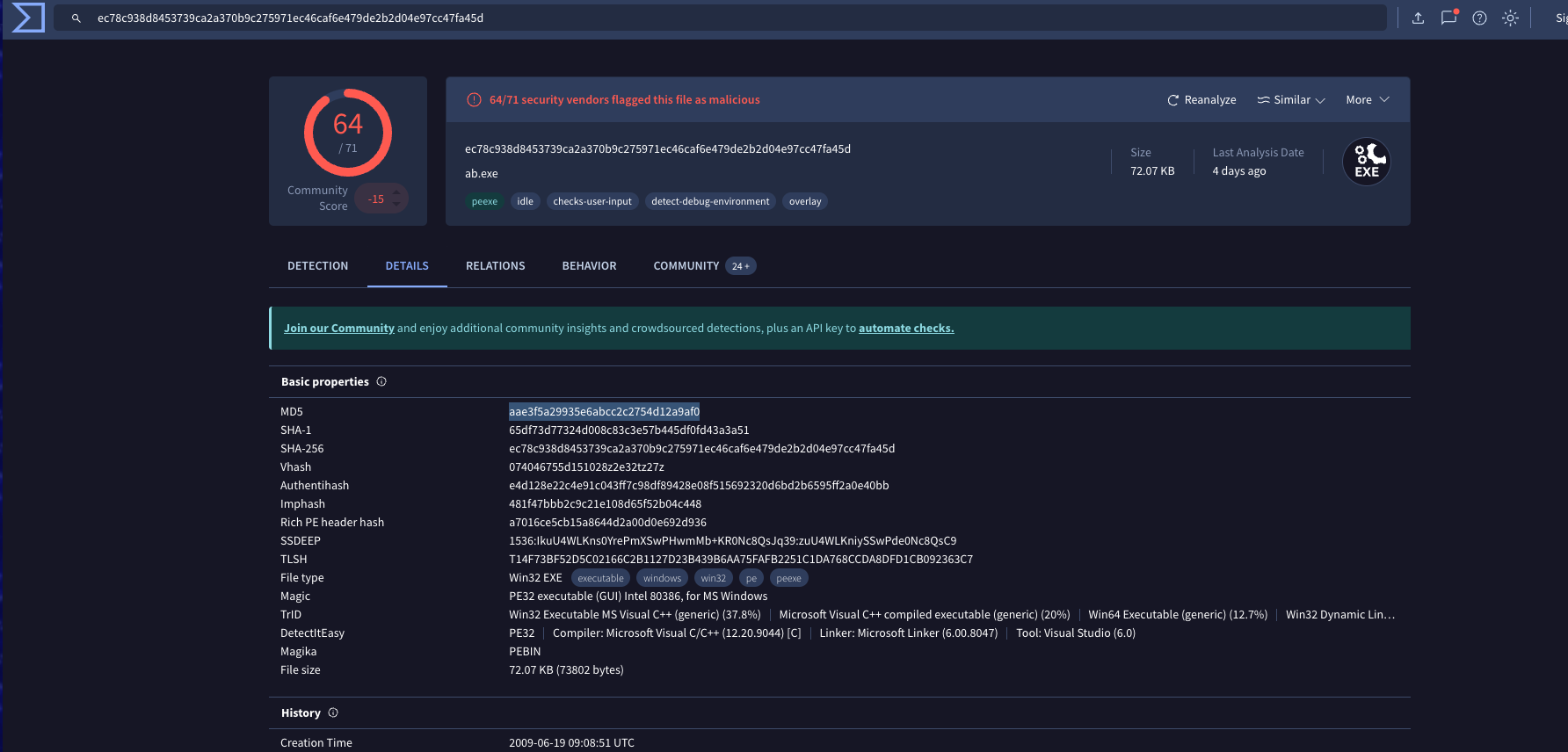
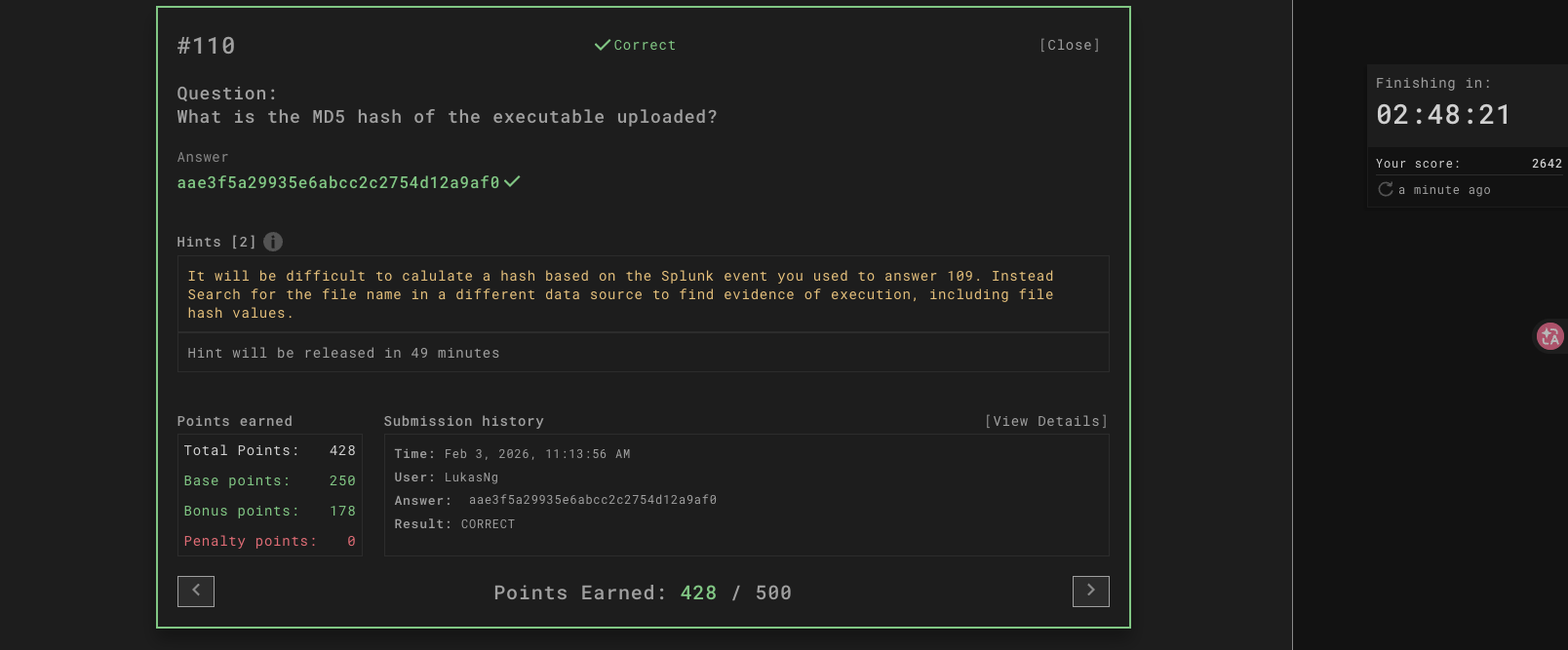
Question: What is the MD5 hash of the executable uploaded?
Answer: aae3f5a29935e6abcc2c2754d12a9af0
Notes
Used file checksum context and VirusTotal lookup to confirm MD5.
Screenshots
Question 111
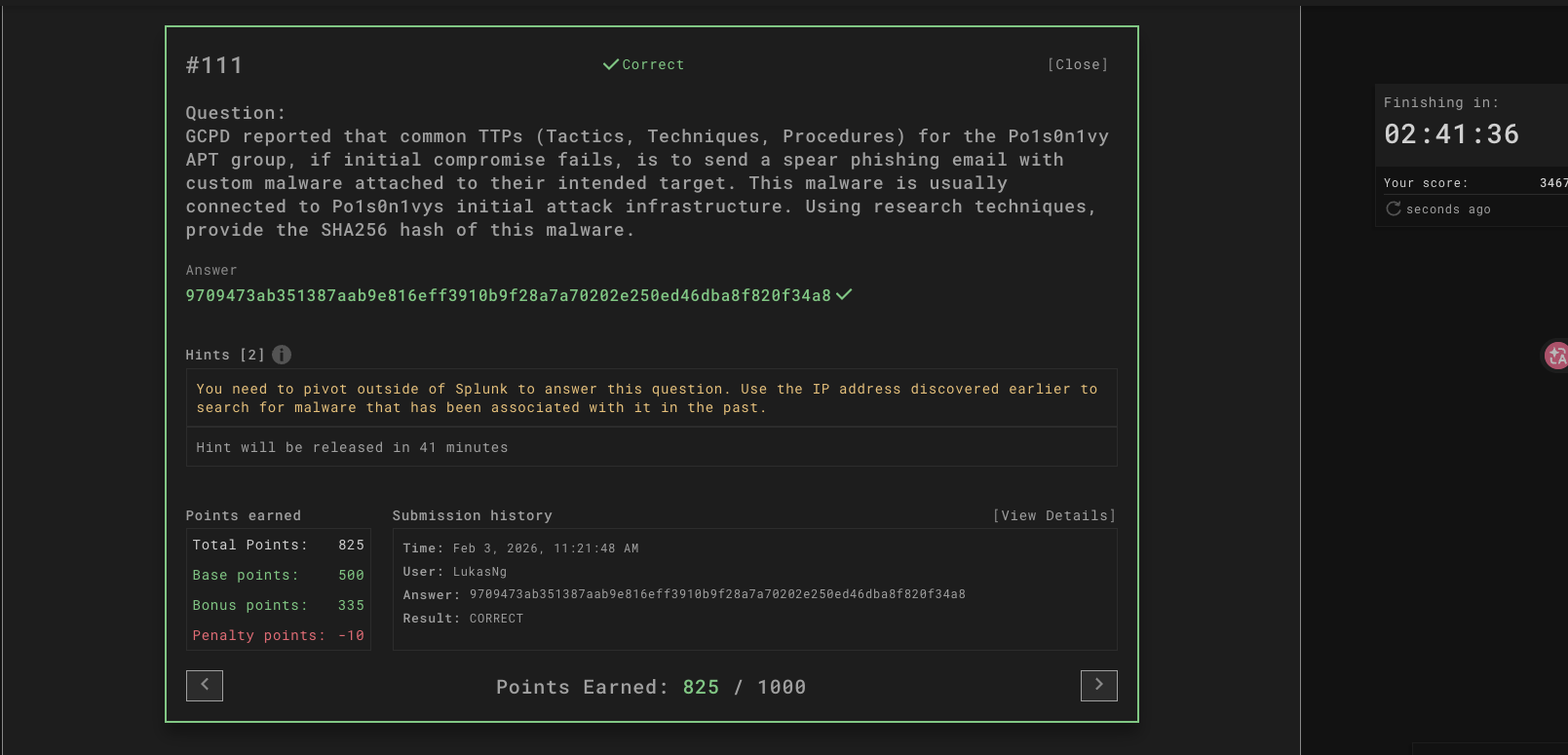
Question: GCPD reported that common TTPs (Tactics, Techniques, Procedures) for the Po1s0n1vy APT group, if initial compromise fails, is to send a spear phishing email with custom malware attached to their intended target. This malware is usually connected to Po1s0n1vys initial attack infrastructure. Using research techniques, provide the SHA256 hash of this malware.
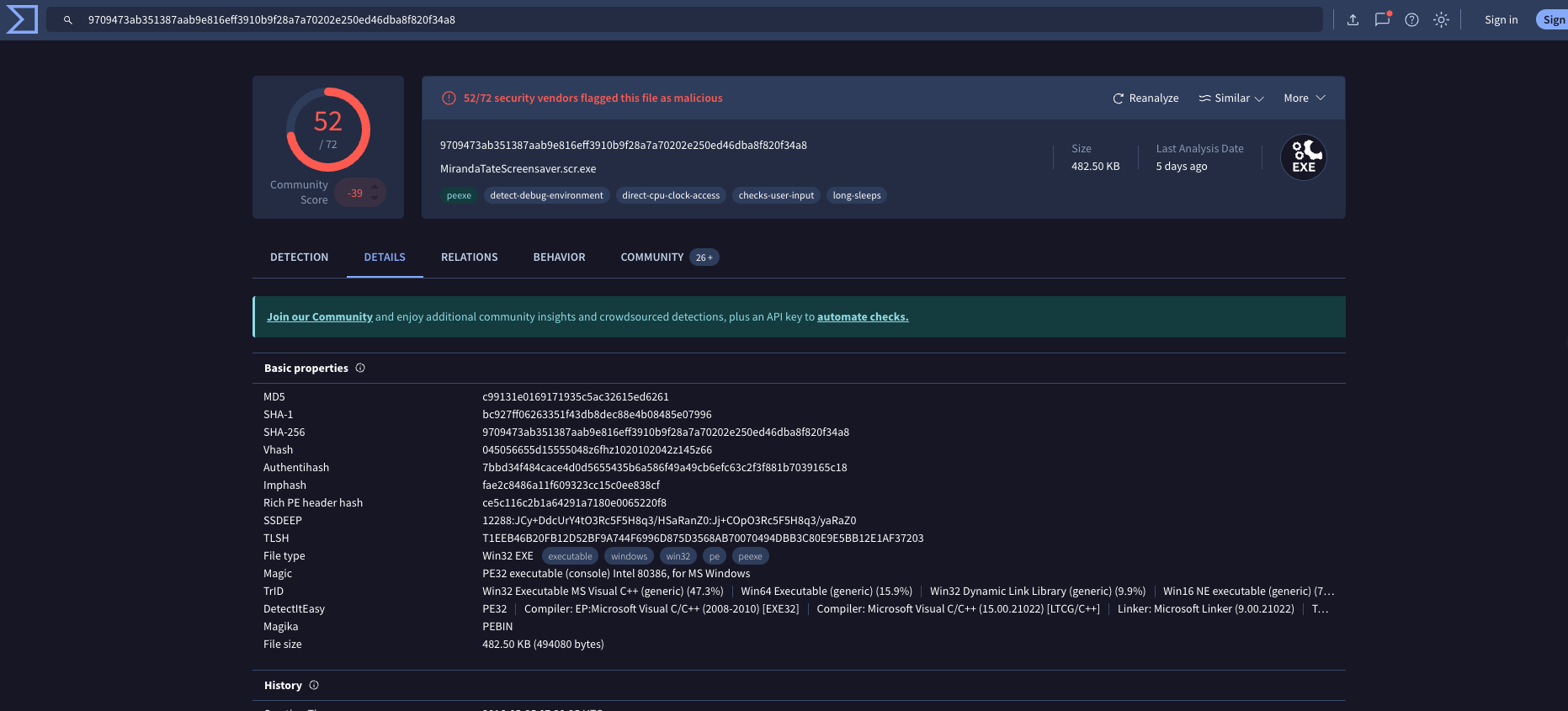
Answer: 9709473ab351387aab9e816eff3910b9f28a7a70202e250ed46dba8f820f34a8
Notes
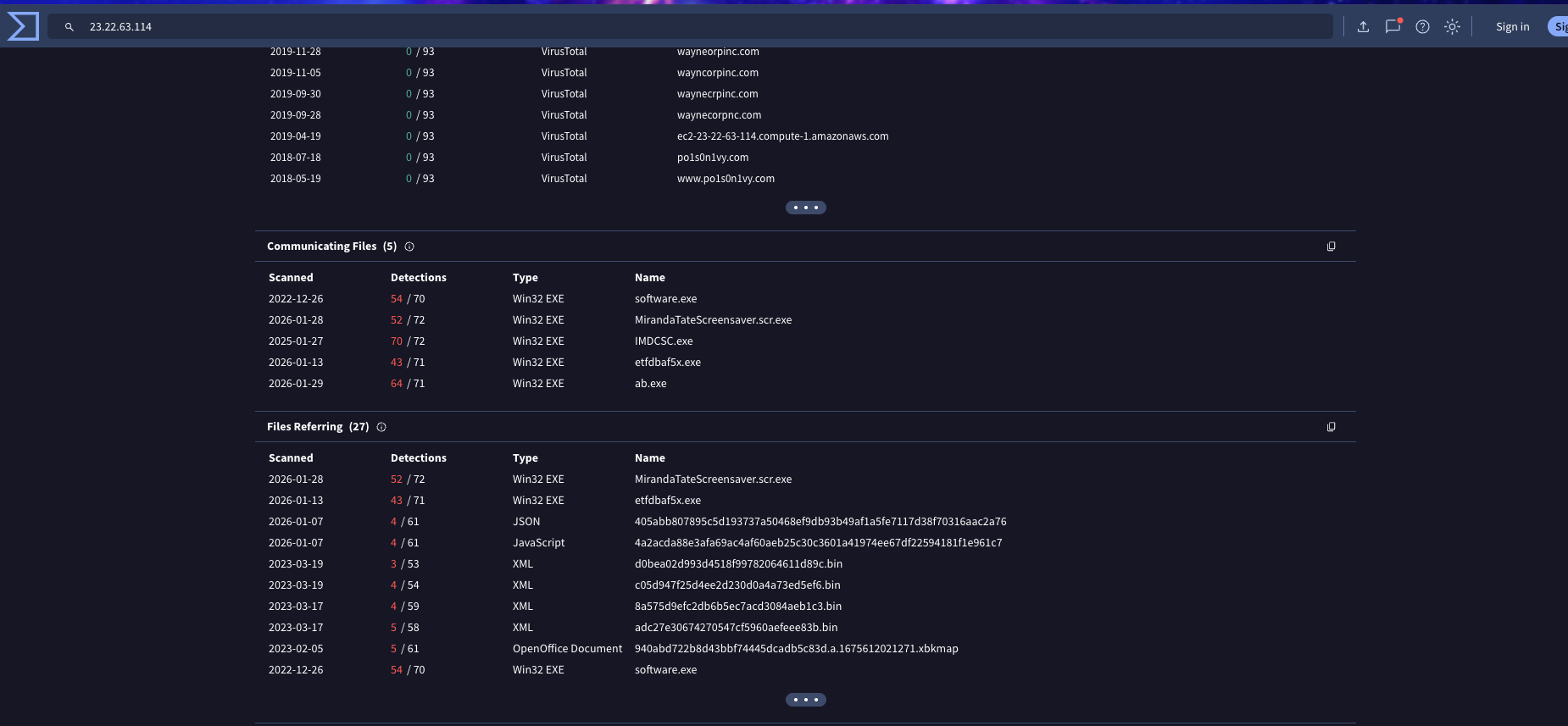
- Pivoted on attacker infrastructure IP:
23.22.63.114. - In VirusTotal relations (communicating/referring files), the candidate was
MirandaTateScreensaver.scr.exe. - Copied the file SHA256 from its details page.
Screenshots
Question 112
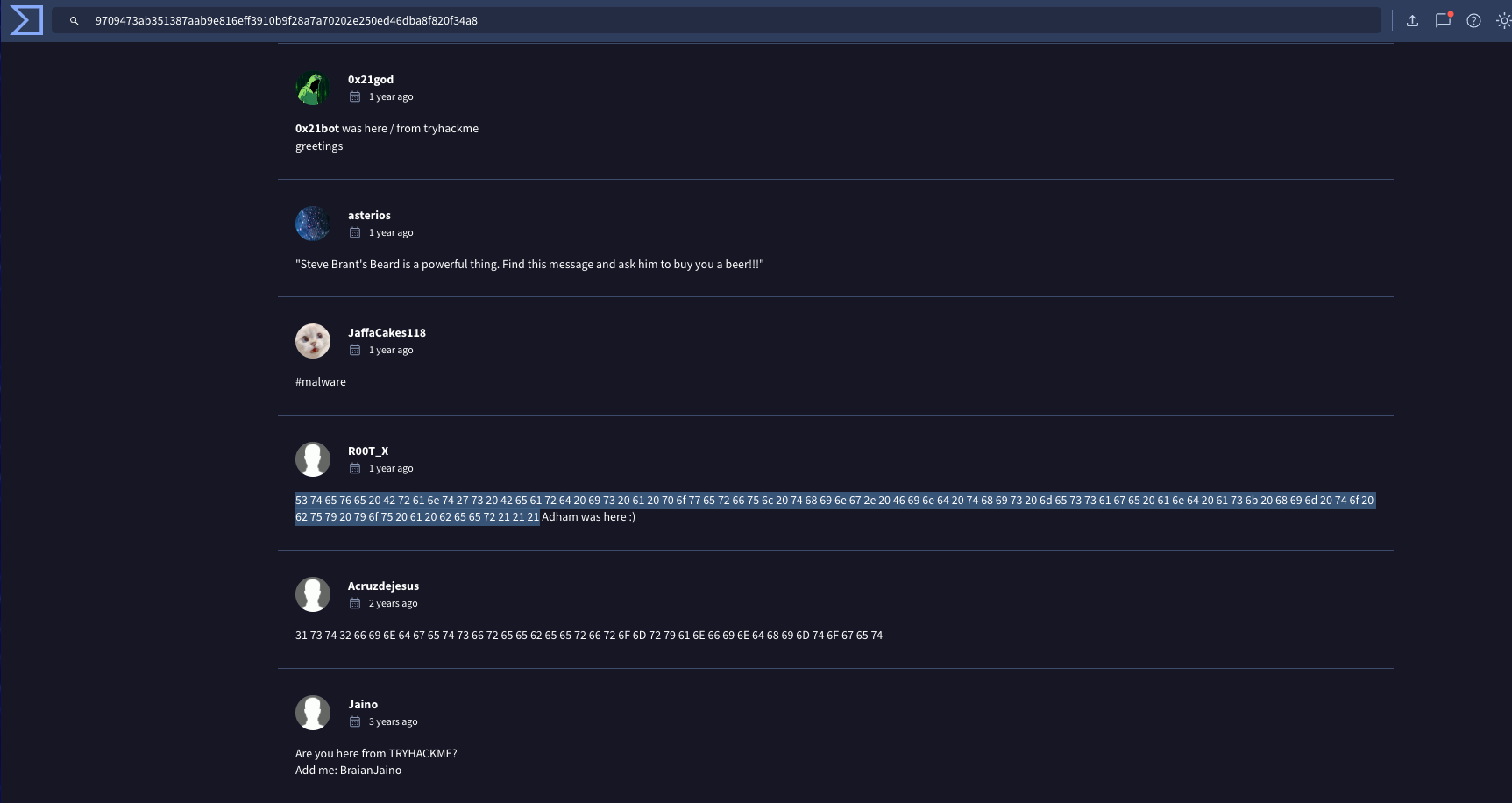
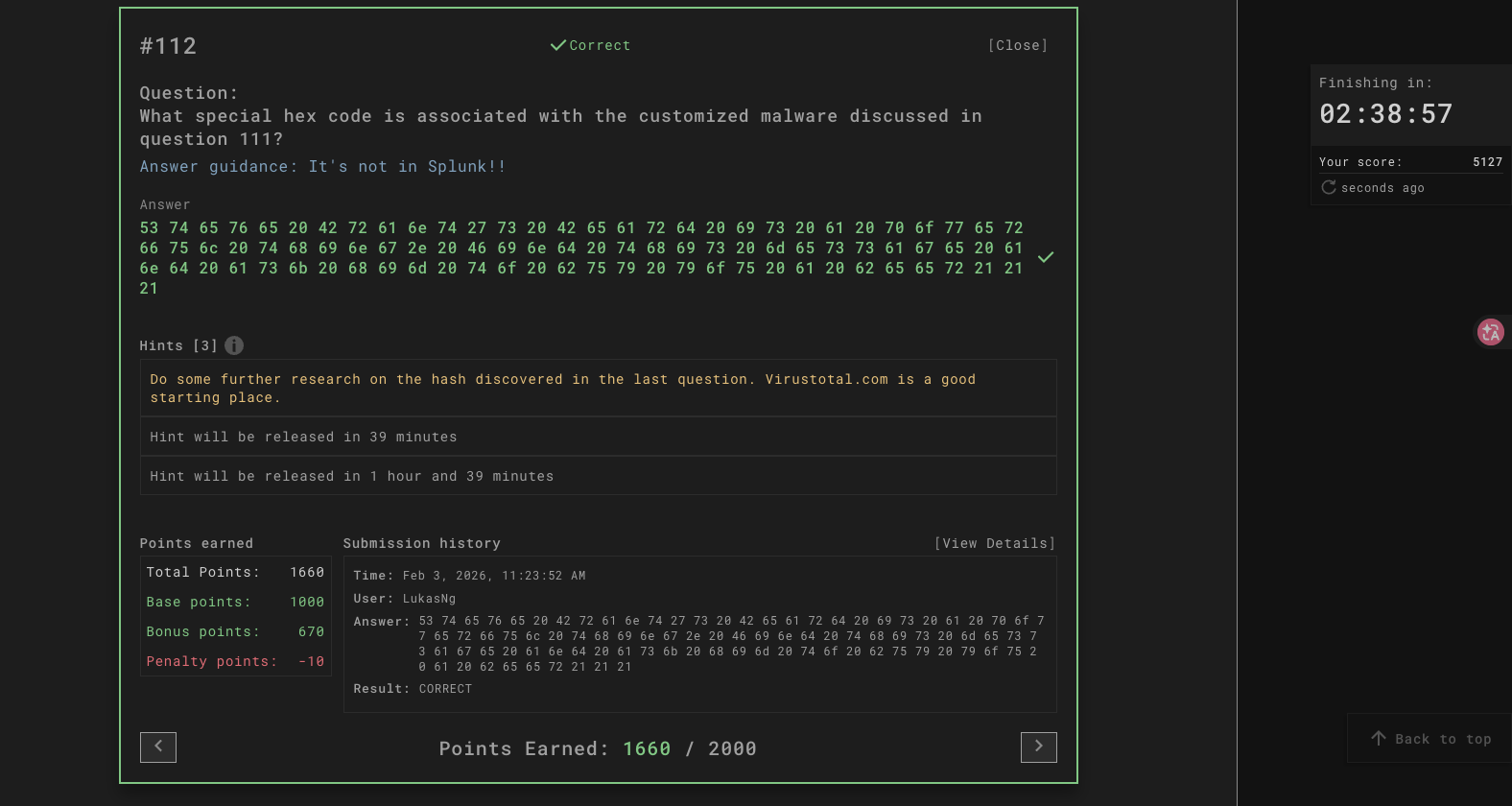
Question: What special hex code is associated with the customized malware discussed in question 111?
Answer: 53 74 65 76 65 20 42 72 61 6e 74 27 73 20 42 65 61 72 64 20 69 73 20 61 20 70 6f 77 65 72 66 75 6c 20 74 68 69 6e 67 2e 20 46 69 6e 64 20 74 68 69 73 20 6d 65 73 73 61 67 65 20 61 6e 64 20 61 73 6b 20 68 69 6d 20 74 6f 20 62 75 79 20 79 6f 75 20 61 20 62 65 65 72 21 21 21
Notes
Hex string was taken from malware discussion/details context in VirusTotal.
Screenshots
Question 114
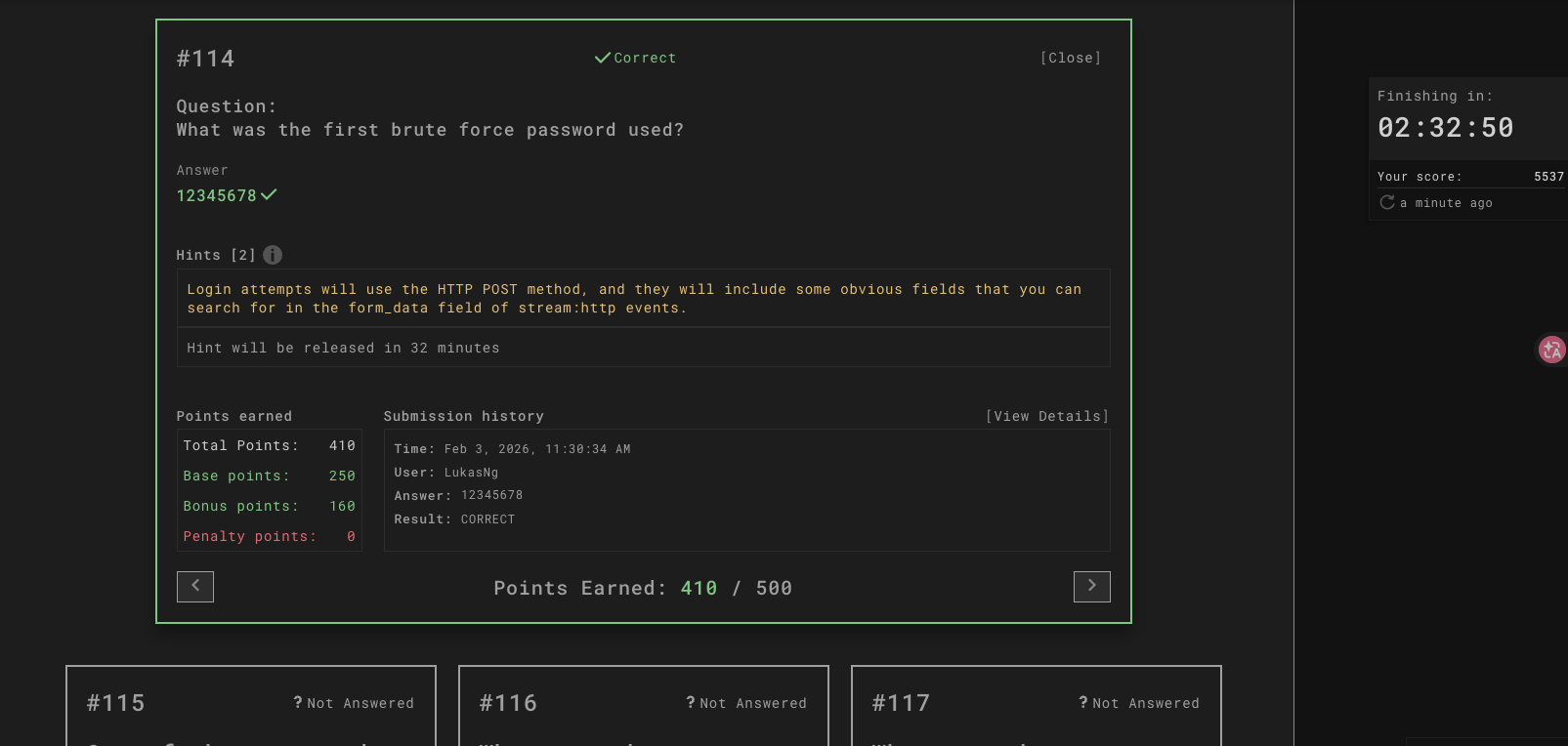
Question: What was the first brute force password used?
Answer: 12345678
Splunk Query
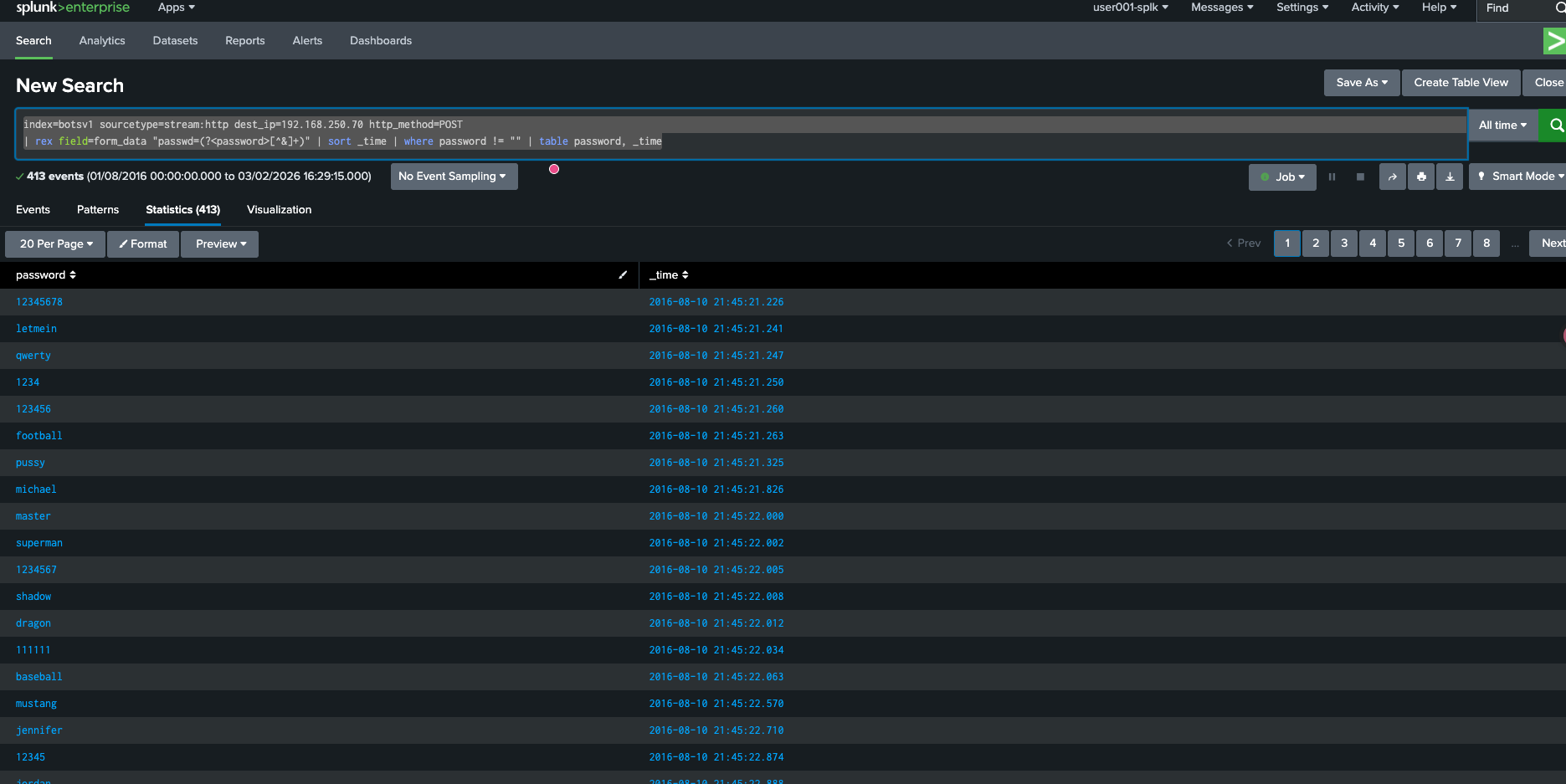
index=botsv1 sourcetype=stream:http dest_ip=192.168.250.70 http_method=POST
| rex field=form_data "passwd=(?<password>[^&]+)" | sort _time | where password != "" | table password, _time
Notes
- Extracted
passwdfromform_data, sorted by time, and took the first non-empty attempt.
Screenshots
Question 115
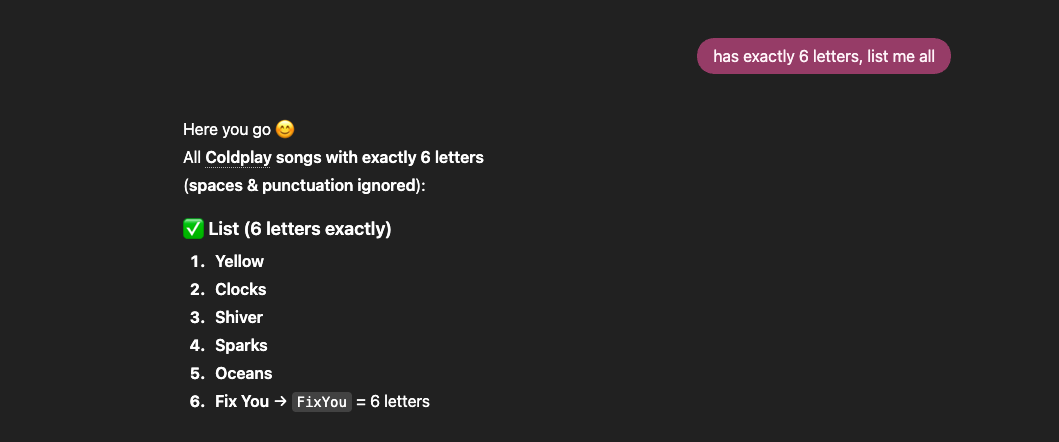
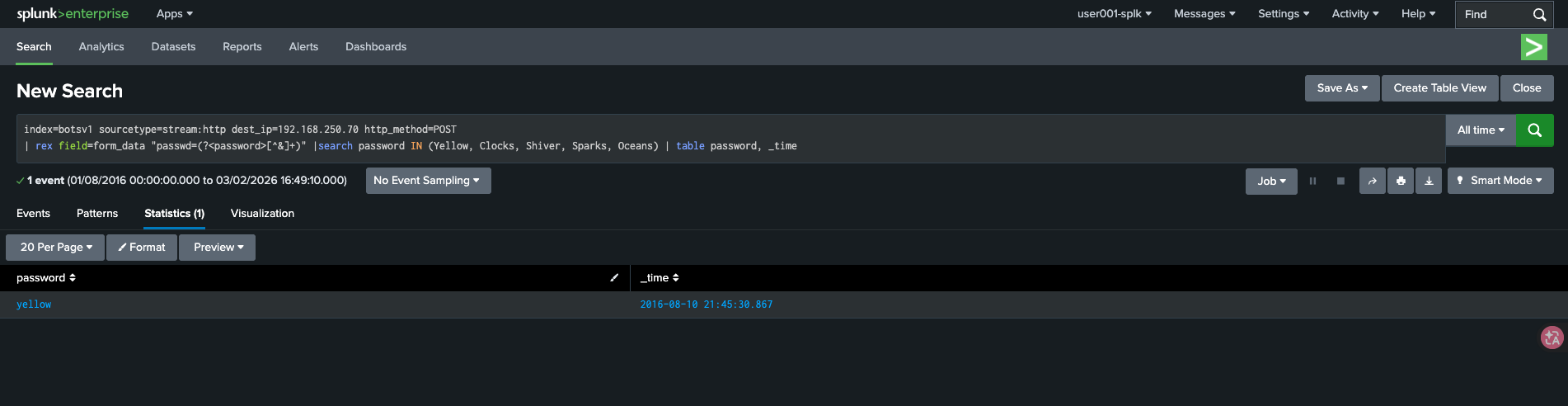
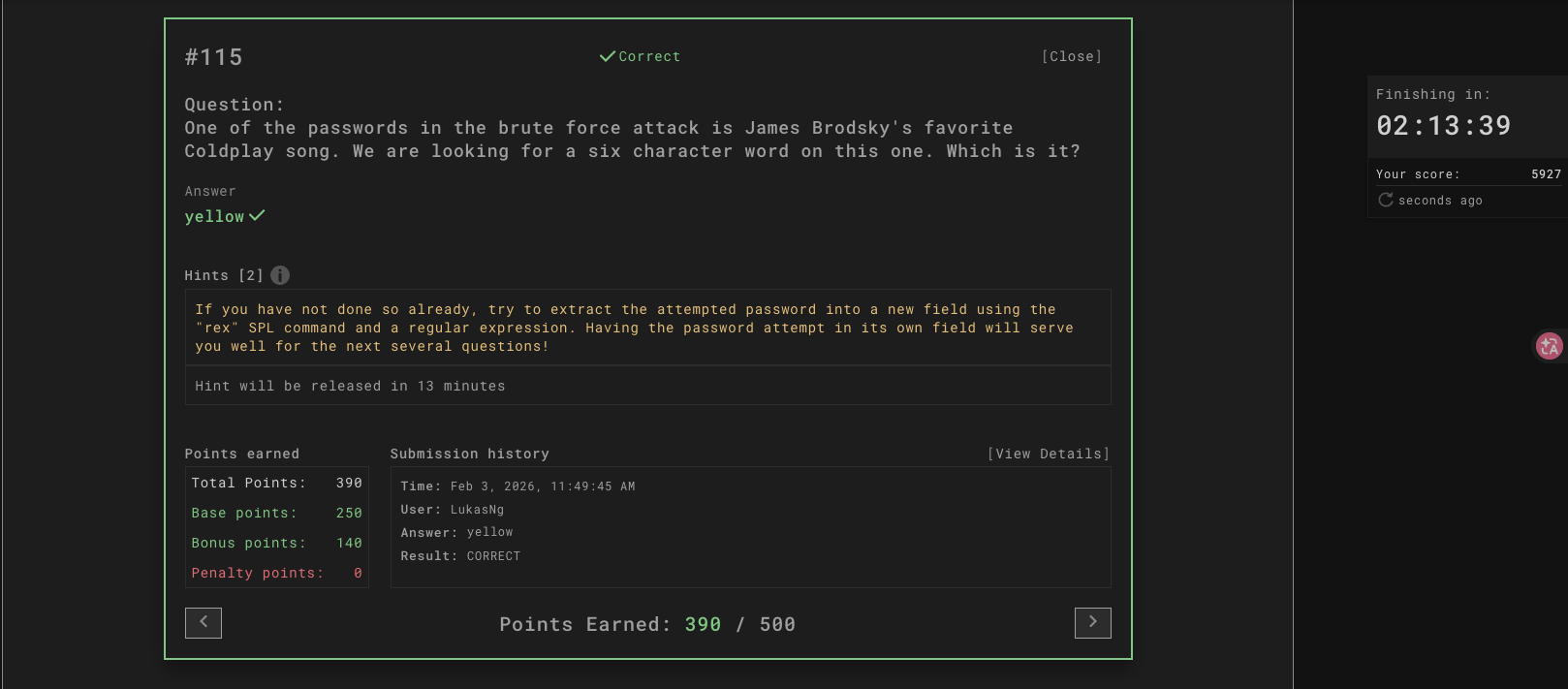
Question: One of the passwords in the brute force attack is James Brodsky’s favorite Coldplay song. We are looking for a six character word on this one. Which is it?
Answer: yellow
Splunk Query
index=botsv1 sourcetype=stream:http dest_ip=192.168.250.70 http_method=POST
| rex field=form_data "passwd=(?<password>[^&]+)" | search password IN (Yellow, Clocks, Shiver, Sparks, Oceans) | table password, _time
Notes
- Filtered extracted passwords against six-letter Coldplay candidates.
Screenshots
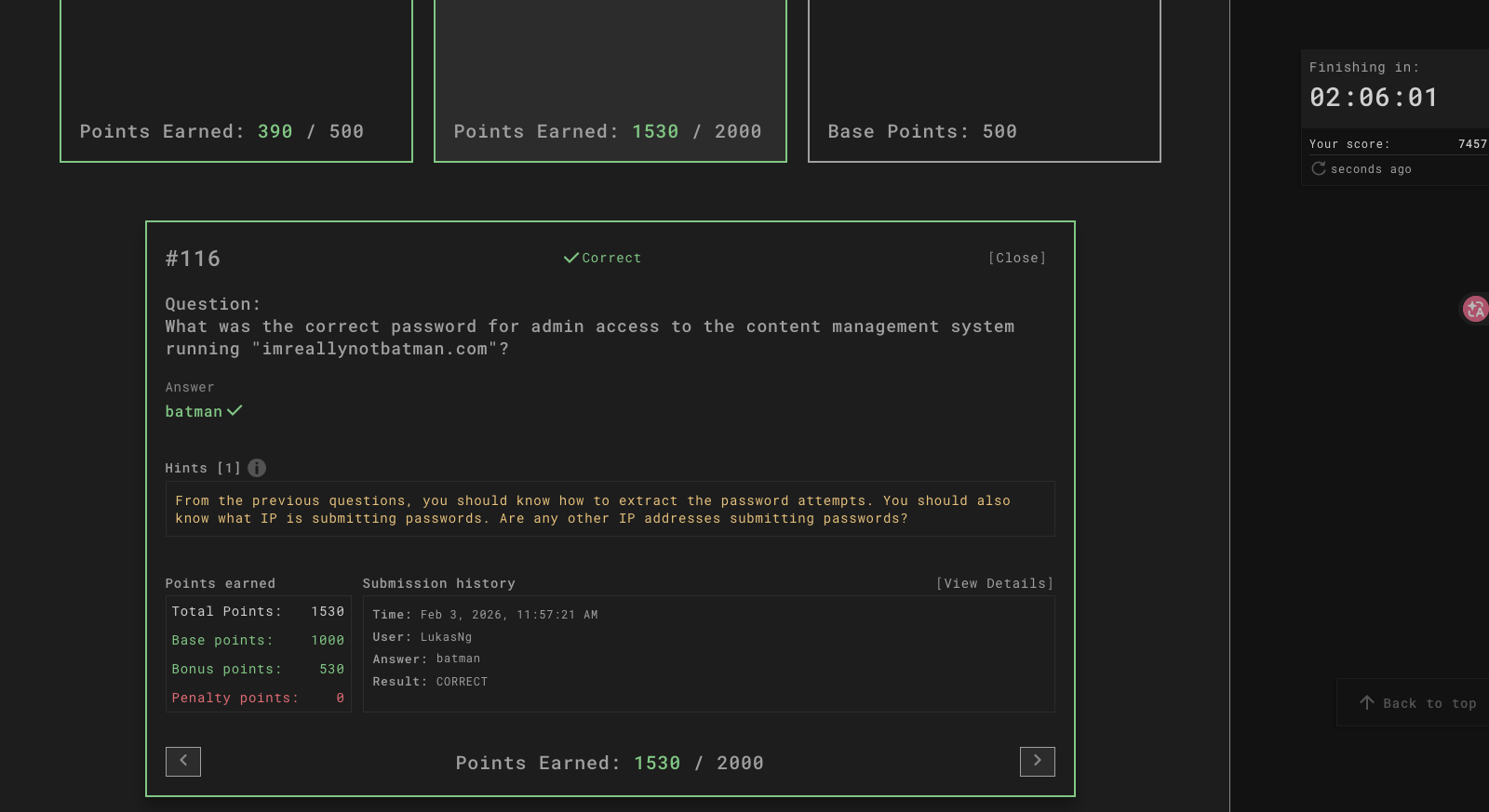
Question 116
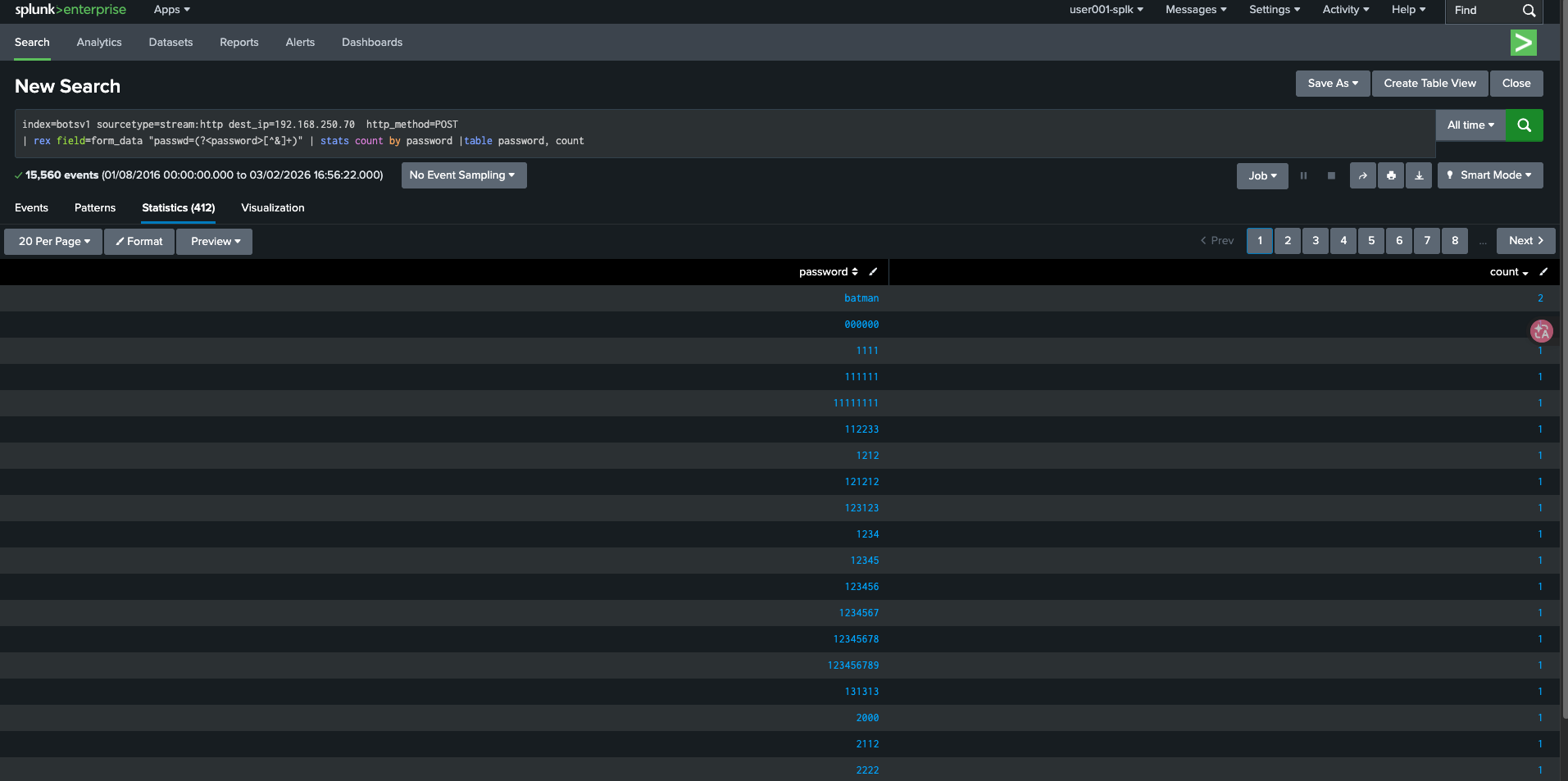
Question: What was the correct password for admin access to the content management system running “imreallynotbatman.com”?
Answer: batman
Splunk Query
index=botsv1 sourcetype=stream:http dest_ip=192.168.250.70 http_method=POST
| rex field=form_data "passwd=(?<password>[^&]+)" | stats count by password | table password, count
Notes
- Counted submitted passwords and identified the credential that matched successful admin access behavior.
Screenshots
Question 117
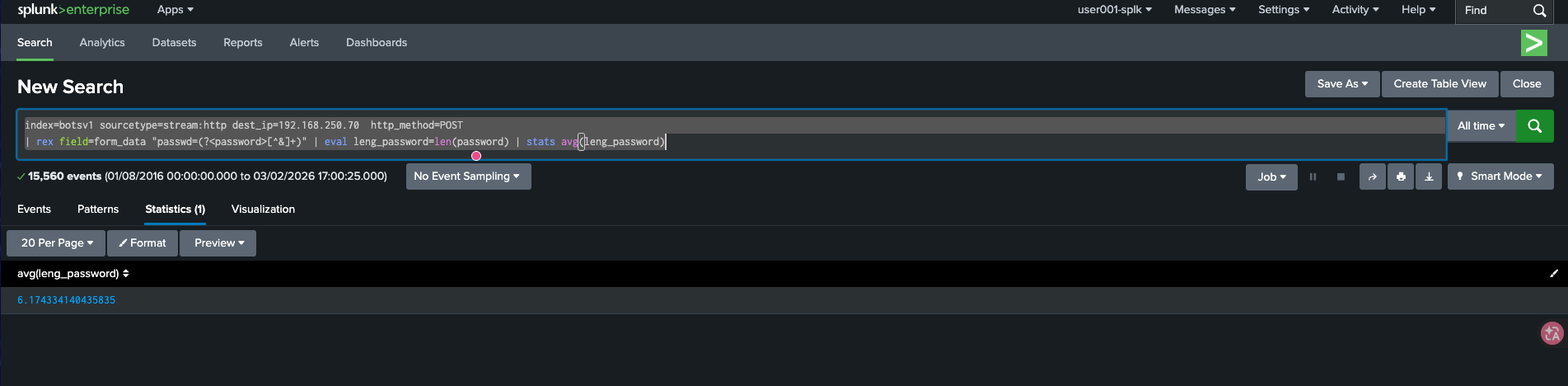
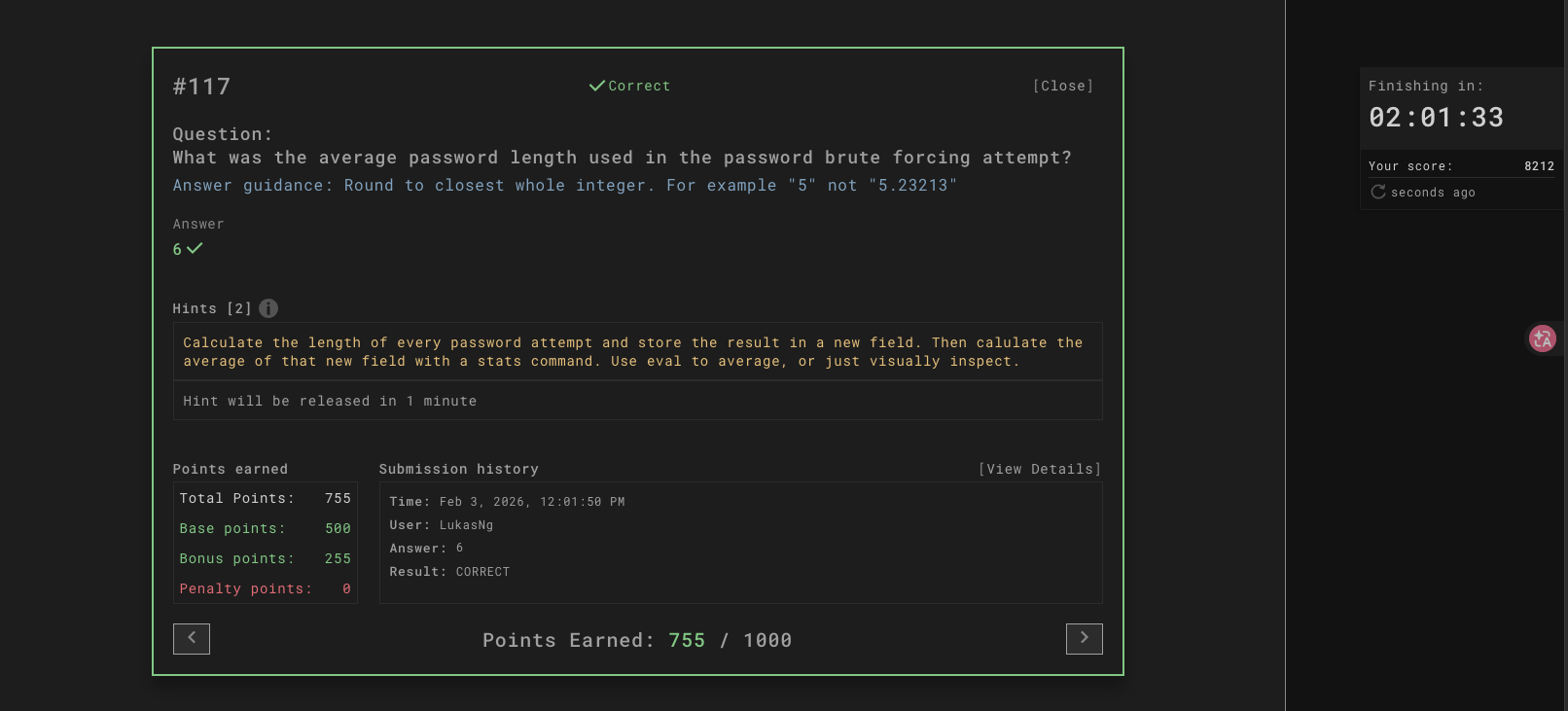
Question: What was the average password length used in the password brute forcing attempt?
Answer: 6
Splunk Query
index=botsv1 sourcetype=stream:http dest_ip=192.168.250.70 http_method=POST
| rex field=form_data "passwd=(?<password>[^&]+)" | eval leng_password=len(password) | stats avg(leng_password)
Notes
- Calculated per-password length with
eval, then averaged withstats avg(...). - Splunk refs:
https://help.splunk.com/en/splunk-cloud-platform/spl-search-reference/10.1.2507/statistical-and-charting-functions/aggregate-functions - Splunk refs:
https://help.splunk.com/en/splunk-enterprise/search/spl-search-reference/9.3/search-commands/eval
Screenshots
Question 118
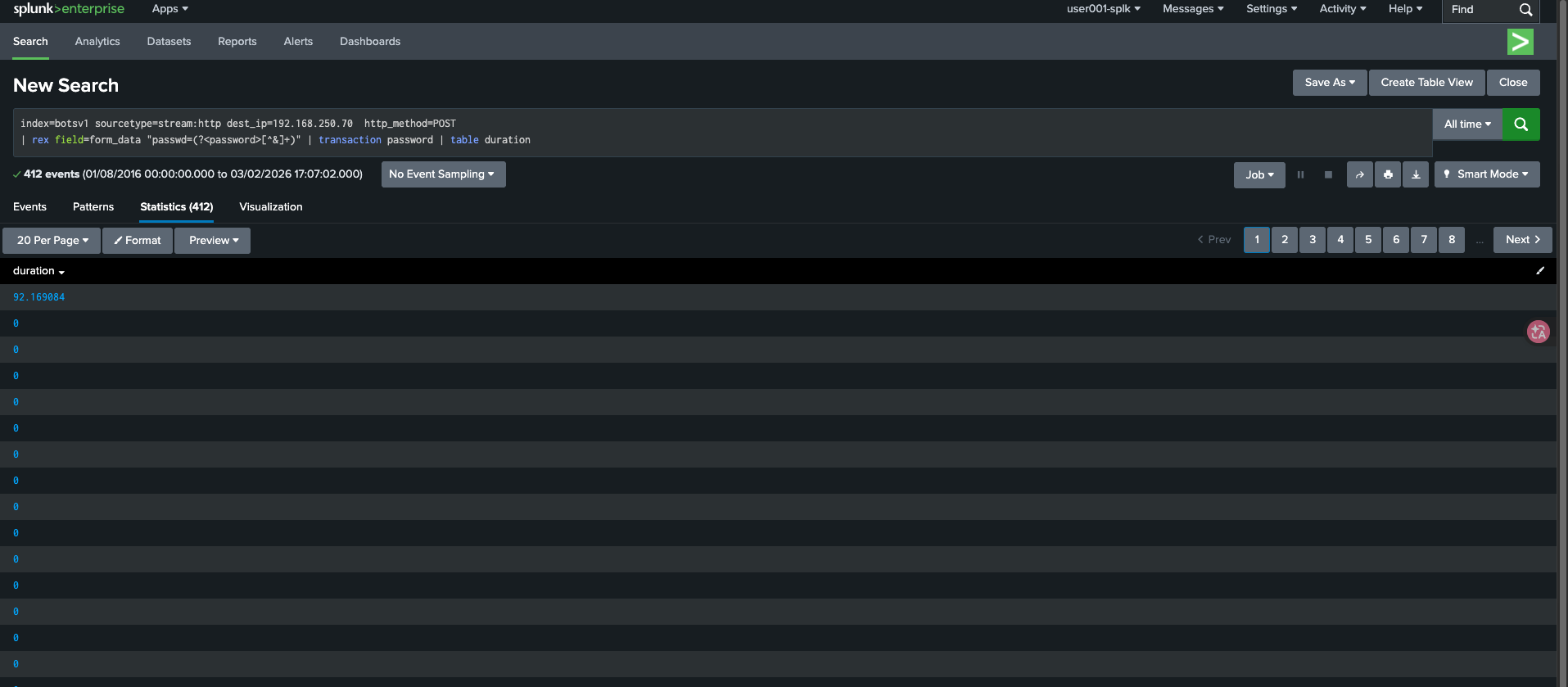
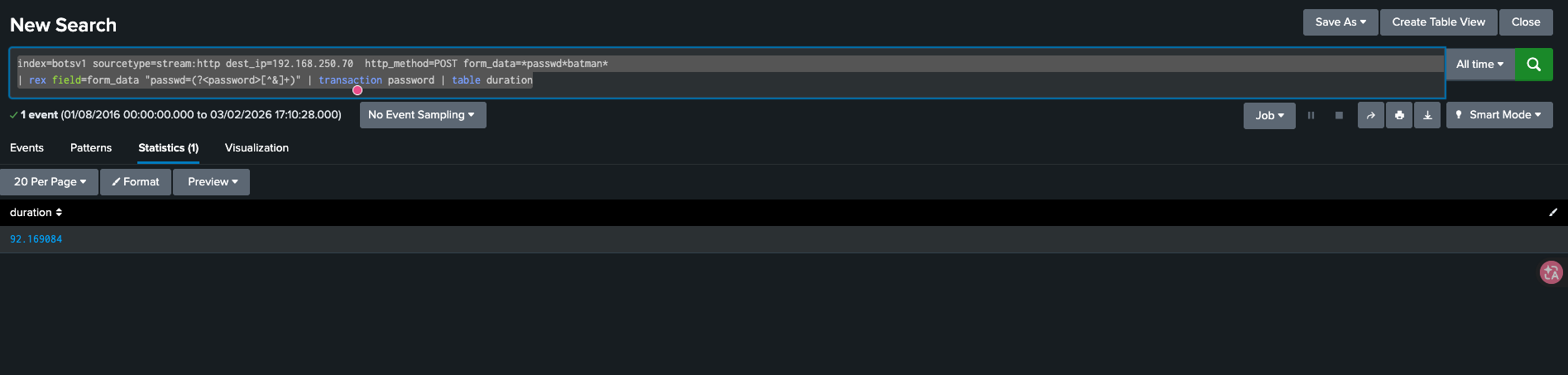
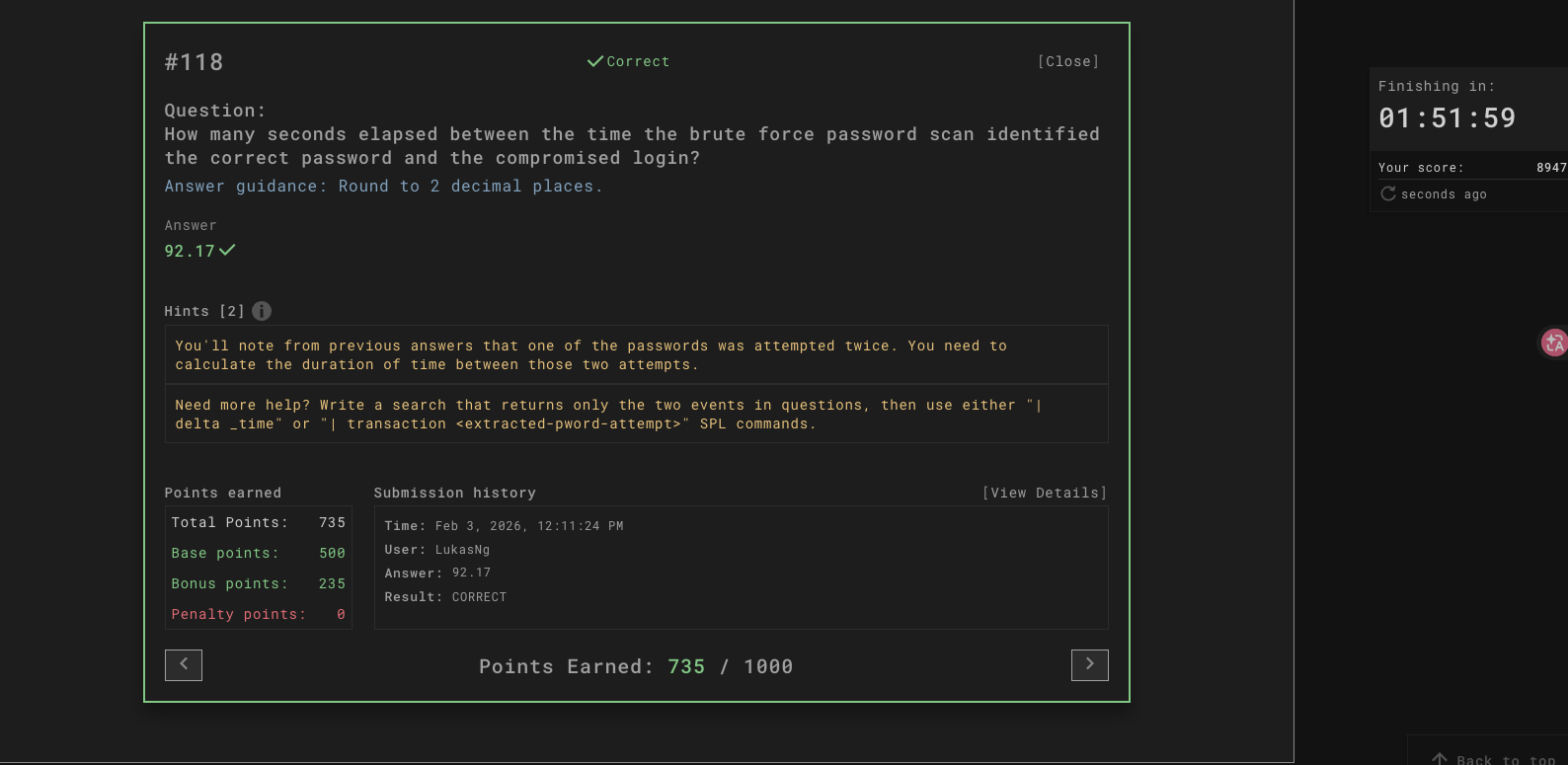
Question: How many seconds elapsed between the time the brute force password scan identified the correct password and the compromised login?
Answer: 92.17
Splunk Query
index=botsv1 sourcetype=stream:http dest_ip=192.168.250.70 http_method=POST
| rex field=form_data "passwd=(?<password>[^&]+)" | transaction password | table duration

index=botsv1 sourcetype=stream:http dest_ip=192.168.250.70 http_method=POST form_data=*passwd*batman*
| rex field=form_data "passwd=(?<password>[^&]+)" | transaction password | table duration
Notes
- Used
transaction passwordon the duplicatedbatmanattempts and readduration.
Screenshots
Question 119
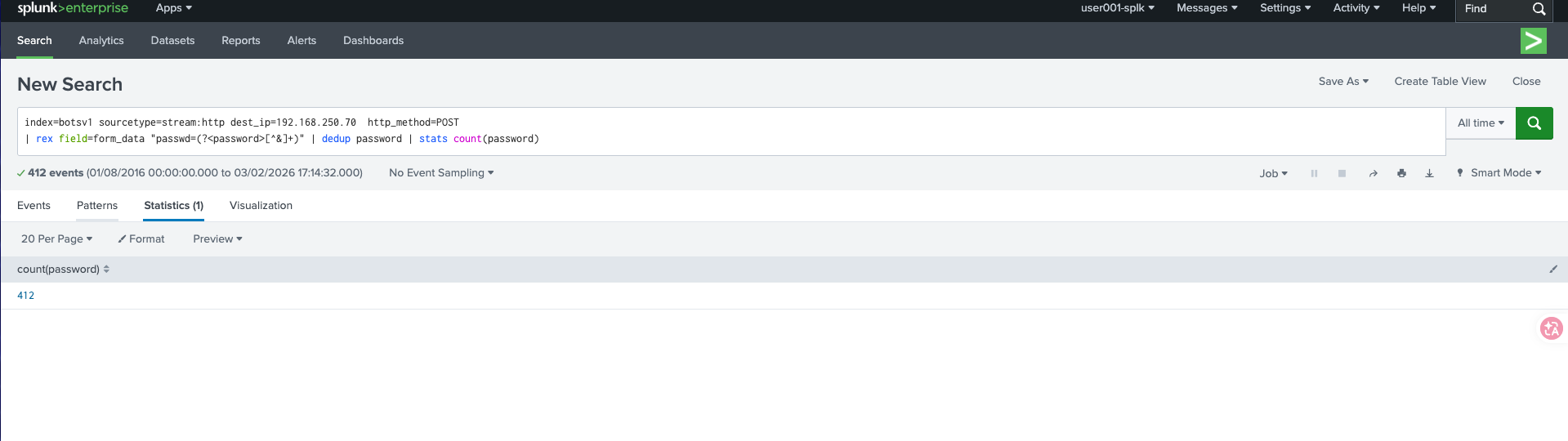
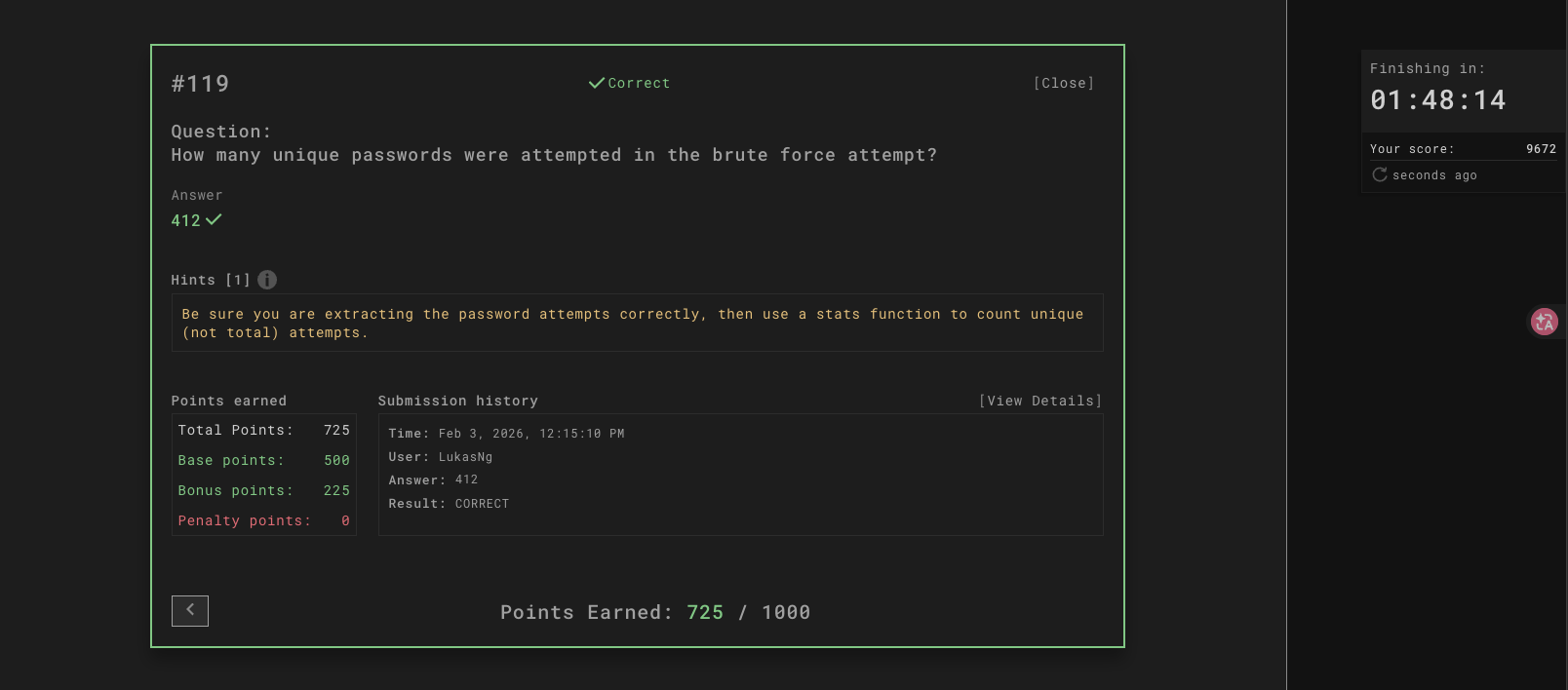
Question: How many unique passwords were attempted in the brute force attempt?
Answer: 412
Splunk Query
index=botsv1 sourcetype=stream:http dest_ip=192.168.250.70 http_method=POST
| rex field=form_data "passwd=(?<password>[^&]+)" | dedup password | stats count(password)
Notes
- Deduplicated password attempts and counted unique values.
- Splunk ref:
http://help.splunk.com/en/splunk-enterprise/search/spl-search-reference/10.2/search-commands/dedup
Screenshots